Overview
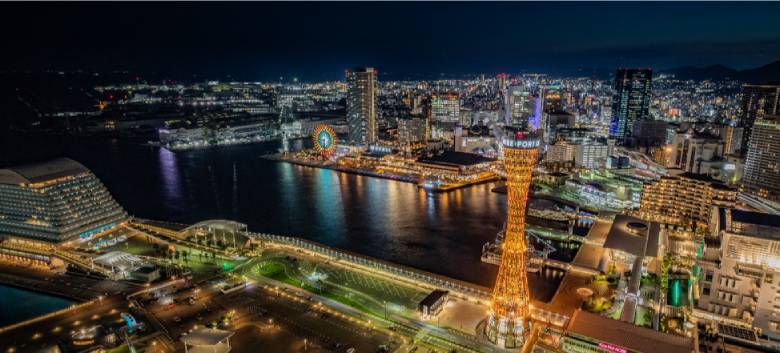
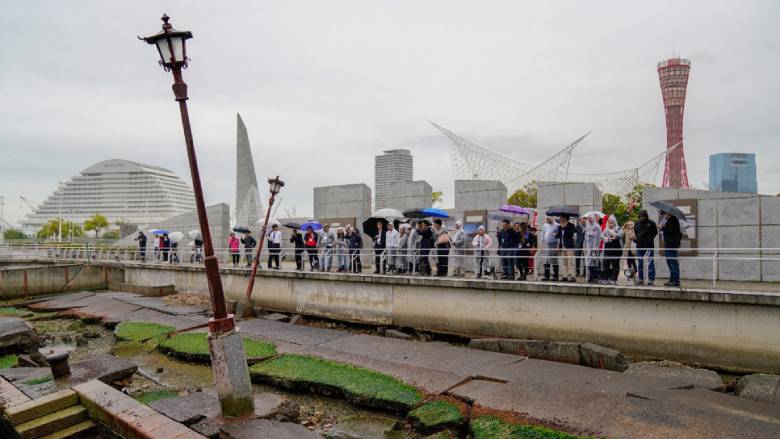
Following the opening of its international seaport in 1868, Kobe developed rapidly and the city has since played an important role in Japan as an economic and cultural gateway to the world. The growth in the city’s economy was initially driven by the shipbuilding and steel industries, and later by manufacturing in fields such as rolling stock and large-scale power generation. In January 1995, Kobe was struck by the Great Hanshin-Awaji Earthquake and many of the city’s industrial plants suffered significant damage.
During the period of rebuilding following the disaster, Kobe launched a ‘Biomedical Innovation Cluster’ project, aimed at developing a center that would excel in the research and development of advanced medical technologies. The project focused on attracting companies in the medical sector in order to revitalize the city’s economy and create a new growth industry. Currently, Kobe boasts over 360 research facilities, venture businesses, hospitals and clinics, and it now one of the largest biomedical hubs in Japan.
The city is also pursuing a “Hydrogen Smart City Kobe Initiative”, which includes a pilot public-private collaboration aimed at establishing a liquefied hydrogen supply chain. Under the guidance of the Japanese government’s GIGA School project, Kobe is also driving the creation of more advanced IT environments in the city’s schools.
With this track record, Kobe became a partner city of TDLC’s City Partnership Program in 2016. It now shares its experience of reconstruction with practitioners and city government officials in developing countries through Technical Deep Dives and other TDLC events. With increasing attention being paid to disaster preparedness and risk management in cities around the world, Kobe's insights are expected to provide important perspectives for urban planners in many other countries.
Key topics of engagement
- Disaster risk management
- Competitive and smart cities
- ICT education
Voice of the city
“Kobe has contributed to urban development in developing countries by providing disaster prevention and mitigation know-how through workshops and seminars, based on our experience of the Great Hanshin-Awaji Earthquake as well as our expertise and knowledge of urban development. As a result of these efforts, we have increased the international visibility of the city and the companies operating here. We also participated in the Smart City Conference that was organized by our fellow City Partnership Program city Yokohama, during which we gained new insights into solutions to urban challenges using disruptive technologies such as artificial intelligence and big data. We therefore believe that our collaboration with TDLC has been mutually beneficial.”
Kenji Uematsu, Executive Director, International Department, Office of the Mayor, Kobe City Government
Key recent collaborations
- August 2025
At the WB TDLC thematic session "Africa’s Urban Awakening: Catalyzing Economic Growth and Jobs" during the 9th Tokyo International Conference on African Development (TICAD9) held in Yokohama, the Mayor of Kobe introduced Kobe City's transformation following the Great Hanshin-Awaji Earthquake and shared experiences in undertaking waterfront redevelopment and infrastructure development to support living environments and new economic opportunities. - February 2025
At the World Bank’s Urban, Resilience, and Land (URL) Forum, Kobe City showcased its earthquake recovery and sustainable urban development efforts, using the Kobe Waterfront Redevelopment Project. - November 2024
TDLC collaborated with Kobe City on hosting the Technical Deep Dive (TDD) on Waterfront Redevelopment, and Kobe City introduced its efforts to revitalize the Kobe waterfront and create a livable city through “creative reconstruction.” - June 2024
At the Understanding Risk Global Forum 2024 TDLC Focus Day Session “Designing Resilient Cities through Data-Driven Solutions in a Riskier World – Lessons Learned from Japan and the World” panel discussion held in Himeji, Kobe City introduced its business reforms and digitalization efforts following the 1995 Great Hanshin-Awaji Earthquake. - May 2022
A city official introduced key lessons and takeaways from Kobe City’s experience in developing the biomedical innovation cluster as part of build back better process after the Hanshin-Awaji Earthquake of 1995 at the Technical Deep Dive on Inclusive Cities and Jobs. - February 2022
A city official from Kobe presented how the city built back better following the devastating 1995 Earthquake and the main challenges in achieving multi-hazard resilience at the Virtual Technical Deep Dive: Disaster Risk Management and Resilient Infrastructure.
*As of January 2026
Key Publications