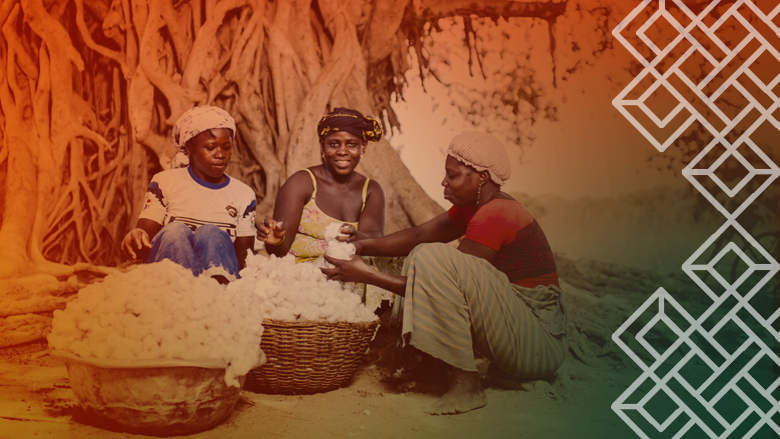
To improve the resilience of households benefiting from social safety nets, the World Bank and Sahelian governments are collaborating to implement a productive inclusion program aimed at promoting the development of income-generating activities.
This program, which successfully reached over 50,000 beneficiaries across four countries during its pilot phase, has undergone various impact and process evaluations. Building on successful results, several countries are in the process of scaling up the program. Resources and tools necessary for program implementation are available.
1. Regional pilot and implementation mechanisms
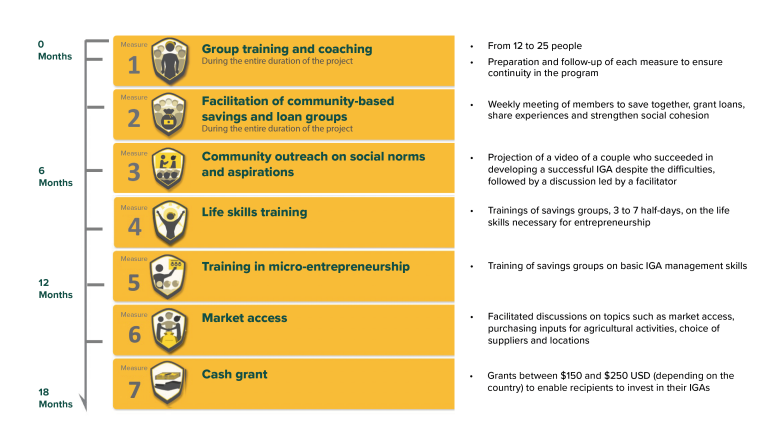
Based on an assessment of the primary constraints faced by poor and vulnerable households, social protection programs in Burkina Faso, Chad, Mauritania, Niger and Senegal were complemented with an integrated package of productive inclusion measures implemented through a regional pilot initiative.
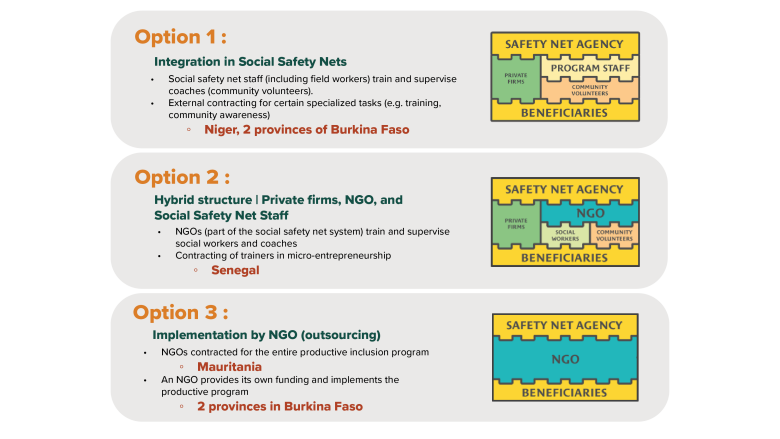
1.1 Based on contexts and capacities, governments have adapted their program implementation arrangements. Monitoring data have shown that these different arrangements have all proven effective in ensuring successful implementation of activities and strong beneficiary participation.
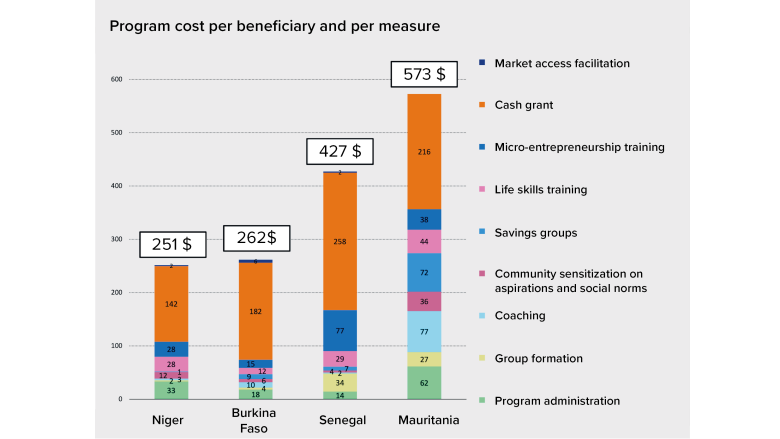
1.2. The implementation of productive inclusion measures through the social safety nets systems has shown strong cost-effectiveness.
The program cost is significantly lower ($250-$575 per beneficiary) compared to the average cost of "graduation" programs implemented by NGOs (often exceeding $1000 per beneficiary). Integrating the program into social safety nets helps manage the cost, but it can vary based on several factors (implementation arrangements, program size and economies of scale, supervision ratios). Productive grants account for 42 to 69% of the total cost.
2. Multi-country evaluation and impact results
The implementation of the regional pilot program has been subject to a multi-country impact evaluation (Burkina Faso, Mauritania, Niger, Senegal). The study has been registered along with its pre-analysis plan. The objective is to measure the program's effectiveness and determine the optimal combination of accompanying measures for productive activities.
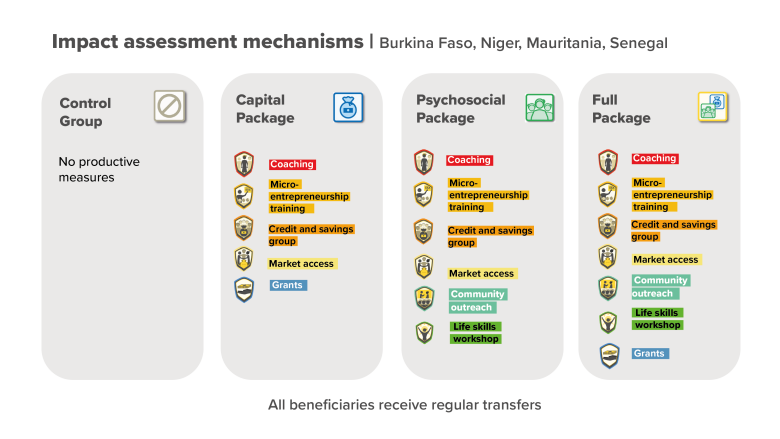
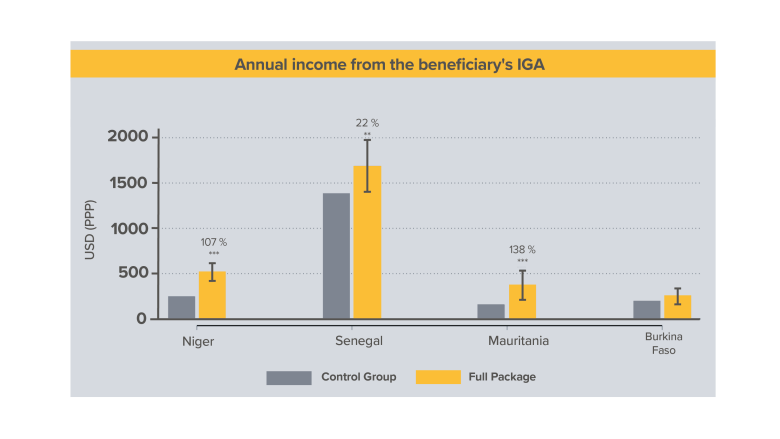
The impact evaluation results have demonstrated the effectiveness of productive inclusion measures implemented by national safety net programs in the Sahel region. The productive measures have substantially impacted economic indicators such as consumption, food security, investments, savings, or income from women’s income-generating activities. The productive measures have helped households diversify their economic activities, and increased investments in non-agricultural activities have led to significant income growth. Diversifying activities beyond agriculture has also helped women strengthen their resilience to climate shocks, as non-agricultural incomes are generally less exposed to climate risks.
The economic impacts are often significant, making productive inclusion measures highly effective in relation to their costs. For instance, in Niger and Senegal, productive inclusion programs have already demonstrated impacts on consumption that exceed the program costs 18 months after the completion of the productive program. The impacts on beneficiaries' consumption are at least 1.2 to 2.1 times higher than the program cost, demonstrating a strong return on investment. Positive effects on non-beneficiaries and the local economy have also been observed in Chad.
Positive impacts on psychological well-being, social cohesion, and women's empowerment have been observed in various contexts. Participants have experienced improved mental health and a stronger sense of social worth at the individual level. They have also reported increased trust in their community. At the community level, the program has enhanced gender attitudes and perceptions regarding women's economic participation. Women have reported having greater decision-making power over their resources. However, some nuances in these effects across contexts have emerged. For instance, the psychological and social well-being increase is more pronounced in rural areas, particularly in Niger.
The impact evaluations also provide information on optimizing the package of productive measures. The psychosocial components (community awareness and life skills workshops) have a strong value-added in increasing economic impacts in rural contexts in Niger and Mauritania. The return on investment is particularly strong for packages with psychosocial components in Niger and Senegal. This shows that it is not only productive grants that make a difference and highlights the importance of addressing the poorest households' psychosocial constraints alongside financial constraints.
Differences between contexts have emerged, highlighting the importance of adapting the contents of the productive inclusion package. For example, in the context of Burkina Faso, a country characterized by conflicts and insecurity, the program has a stronger impact on savings than investments.
The results from Niger were published in 2022 in the scientific journal Nature ("Tackling psychosocial and capital constraints to alleviate poverty"), along with a summary (“Addressing social, psychological and economic barriers helps people out of extreme poverty”). Results for other countries are in the process of being published.
2.1. Qualitative evaluations of implementation.
Three qualitative evaluations of the implementation of the pilot program were conducted in Niger, Senegal, and Mauritania. These studies provided a better understanding of the design and implementation of various activities. They contributed to the interpretation of the results from the multi-country impact evaluation and supported the formulation of recommendations for scaling up.
2.2. Monitoring and evaluation reports
The pilot program's administrative monitoring and evaluation data were analyzed in a report, highlighting the significant rate of beneficiary participation in various activities.
3. Scaling up the redesigned program
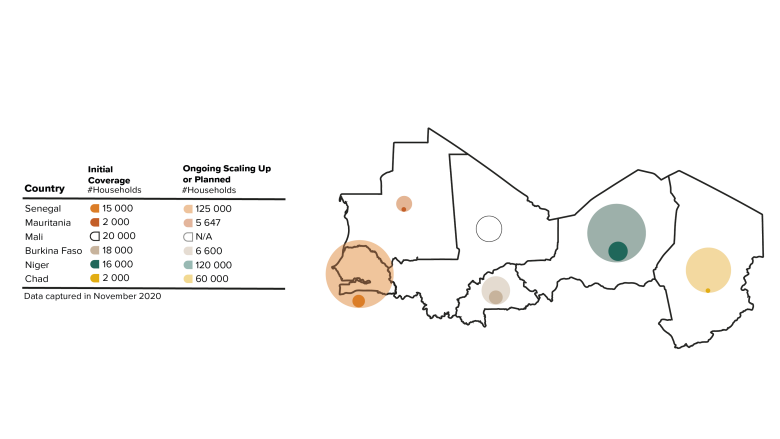
The scaling up of the productive program is underway or planned in different Sahel countries and will cover over 315,000 households in the region by 2027.
4. Toolkits for the implementation of productive measures
Resources and tools
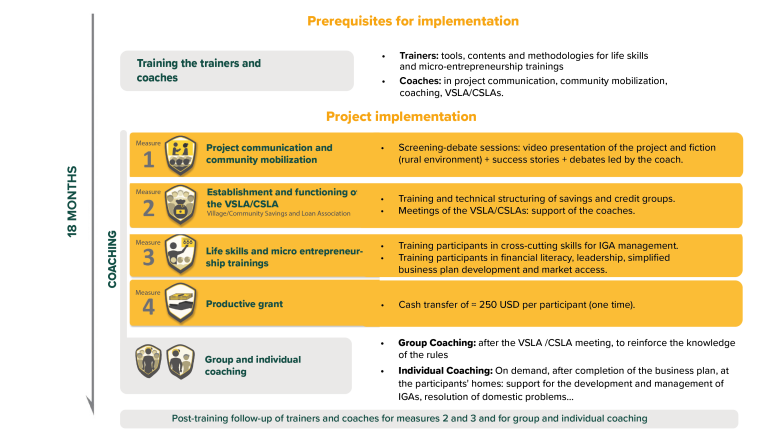
The presented tools aim to inspire the design and/or various adaptations of the productive inclusion project. They were developed as part of the project's scaling-up in Senegal and Chad:
- Video presentation of the YKK project in Senegal and video presentation of productive mesures project in Chad - in French
- Video 3D AVEC - French version (available in local languages - Arabic, Wolof...)
- Summary note on productive inclusion measures (French version)
- Community awareness videos in Senegal and Niger