00:23 My name is Lena Mwangi.
00:25 I am the founder of Inuka Agris Solution.
00:29 It is an associate enterprise
00:31 that is,
00:32 uh,
00:33 agri-oriented.
00:34 We are using
00:36 agriculture as a tool to transform our community.
00:39 Through training and
00:42 empowerment on good practices for agriculture,
00:45 we started by farming of poult trees
00:48 and
00:49 doing some veggies.
00:51 That is helping most of us as youths within Akuru region
00:54 to realize
00:56 or to be engaged
00:58 in some of the activities that are helping
00:59 us sustain ourselves when we train farmers.
01:03 They have not been paying for the trainings.
01:05 So our win is them coming to buy from our shop.
01:08 We have an agro shop
01:10 and,
01:10 uh,
01:10 they can buy the inputs from us after we've trained them.
01:13 Then we always follow up to know how
01:15 they're utilizing the knowledge we've given them.
01:17 And then after that we normally link them to the market.
01:21 We gain a lot of knowledge from these people.
01:23 It is not only coming themselves,
01:25 but they invite other farmers
01:27 from other groups.
01:28 As a graduate,
01:29 I had not got somewhere to engage myself.
01:31 After the training,
01:33 I got somewhere.
01:34 Than waiting for employment,
01:36 I got somewhere to employ myself,
01:38 and this has helped most of us
01:40 who are here,
01:40 be it from four levers,
01:41 be it those who have graduated and have not got places
01:44 to involve themselves.
01:46 We have come together as a group now.
01:47 We have started doing this farming
01:49 and we are selling our products.
- font-medium
- bg_blue_05
STORY HIGHLIGHTS
- Kenya is coming up with ways of improving the safe production of popular, traditionally fermented milk.
- Fermented milk is often produced in non-standardized, unhygienic conditions that carry a food safety risk.
- The Kenyan government is building local capacity to produce starter cultures that make milk fermented in traditional ways safer to drink and more commercial.
- lp-body-content
- first-letter
Milk fermented in traditional ways is a popular part of the day-to-day diet of many Kenyan communities. From Mursik, popular with the Kalenjin, to Amabere amaruranu and Kule naoto, consumed by the Kisii andMaasai communities respectively, fermented milk is a key source of nutrition. Often, however, the way these variations of fermented milk are prepared falls far short of best practices in food safety and ends up posing health concerns for consumers.
Mitigating the risks brought about by unsafe food is one of the challenges being addressed by the Centre of Excellence in Sustainable Agriculture and Agribusiness Management (CESAAM) based at Egerton University in Kenya. The Centre is one of 24 supported by
the Eastern and Southern Africa Higher Education Centers of Excellence Project (ACE II), funded by the International Development Association (IDA) of the World Bank.
The project supports higher education in areas of priority to regional development, such as industry, agriculture, health, education, and applied statistics, with each ACE receiving a grant of up to $6 million to carry out the research it proposed. An extension of ACE I, a similar project in West and Central Africa, ACE II operates in eight countries, Ethiopia, Kenya, Malawi, Mozambique, Rwanda, Tanzania, Uganda, and Zambia.
Africa’s population is growing, and food security is an increasingly important challenge to address. “One aspect of food security is food safety. Here in Kenya, we have different communities producing different types of fermented milk. These products are produced in a traditional way, which means the process has not been standardized,” said Dr. John Nduko, a lecturer at Egerton University’s Department of Dairy, Food Science and Technology, who holds a PhD in Chemical Sciences and Engineering.
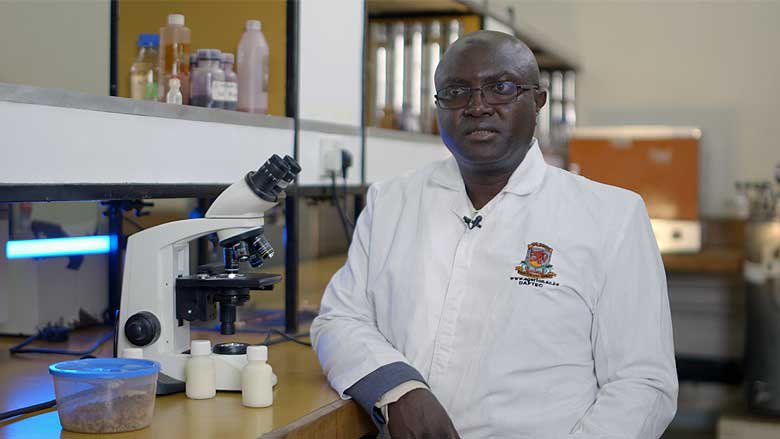
To accelerate standardization, CESAAM is facilitating the development of starter cultures that could be distributed to the mass market. A starter culture is a batch of micro-organisms, used in foods such as fermented dairy products, of which yoghurt is a typical example.
Local starter cultures are not yet manufactured widely and in controlled conditions, in the country. “In Kenya, most of the starter cultures used in the production of fermented products are imported. This means that all the products you see in the market, like yoghurt, rely on imported starter cultures,” said Nduko.
CESAAM is not only improving the food safety of traditionally fermented milk but it also seeks to make sure it can be commercialized and to help producers generate sustainable, steady incomes from it. This is being done through the domestic production of starter cultures.
“By locally producing these starter cultures, we can be able to generate our own products from our traditionally fermented milk, and even the local communities will be able to produce them, which means they will be able to contribute to manufacturing using indigenous knowledge,” Nduko said.
Buying local
The local production of starter cultures is an example of the impact CESAAM is having in strengthening food security, food safety, and, in turn, public health and human capital. The Centre has been pivotal in making starter cultures scalable and available.
ACE II began in 2016 and is due to run to 2025. “When CESAAM started at Egerton University, we had just started with production of these products, and we were able to identify the micro-organisms,” said Nduko. “By then, what we had produced was basically for research.”
Outside funding has made it possible for it to take a new product to the market, scale it up, and get it registered. The Centre worked with the Kenyan government to make sure its innovation received the policy support it needed to accelerate public uptake. “We have had discussions with the Kenya National Innovations Agency, which has created what it calls ‘The Innovation Bridge’.”
Once loaded onto a designated website, the agency can link CEESAM’s product to industries with a possible interest in its potential. The rollout of local starter cultures is expected to benefit women in particular, and to help counter gender-driven income disparities among them, especially in rural areas of Kenya. This, Nduko said, was important. “When we were doing the analysis of these products, we ensured that our research was gender sensitive because we realized that, in most cases, it is the women who are involved in the production of the fermented milk products.”
The World Bank is a key contributor to regional collaboration and integration across Africa, helping prioritize human development. The ACE I and II projects support the development of some of the professional skills needed for innovation and research.
RELATED
- lp-body-content
- first-letter
