- font-medium
- bg_blue_05
STORY HIGHLIGHTS
- International Jaguar Day on November 29th raises awareness about the increasing threats facing the jaguar and the critical conservation efforts needed to ensure its survival.
- These efforts stretch from the local, national and regional levels to high-level international initiatives seeking to protect the jaguar and its habitat.
- The GEF-funded Global Wildlife Program works in three jaguar-range countries Belize, Ecuador, and Panama to address multiple threats such as habitat loss and fragmentation, human-jaguar conflict, and the trafficking of jaguar parts.
- lp-body-content
- first-letter
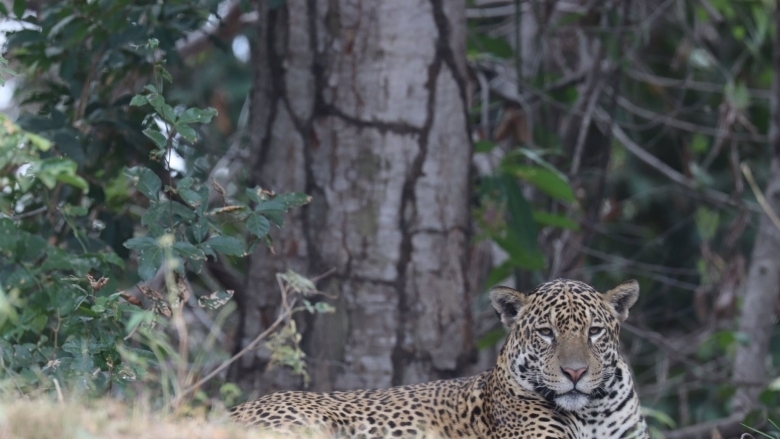
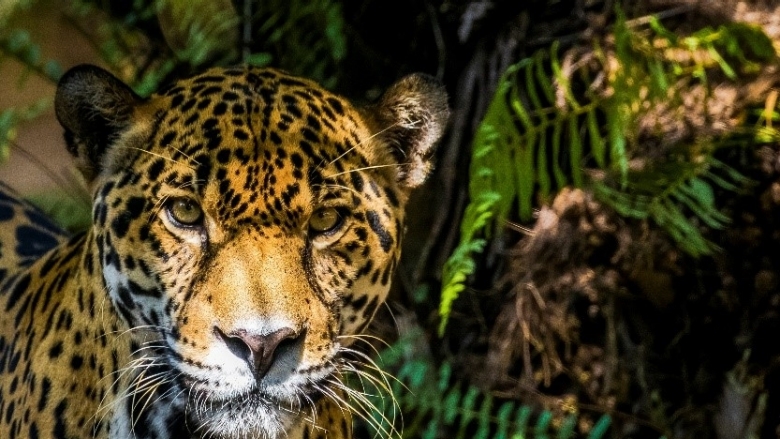
The jaguar—the largest cat in the Americas and the third largest in the world after lions and tigers—roams a vast stretch of land from northern Mexico to Argentina known as the Jaguar Corridor. But that corridor has dwindled to just 50% of its historic range. Ironically, one of the many symbolisms attributed to jaguars is protection, but today the fate of jaguars lies in humans being able to protect the habitat it roams in.
In 2018, a high-level forum brought together representatives from 14 jaguar range countries along with practitioners to kickoff region-wide cooperation for jaguar conservation. This led to the 2030 New York Statement. Following this, a Jaguar 2030 Conservation Roadmap for the Americas united various stakeholders around a shared vision to conserve jaguars. This strong regional coordination was reemphasized at the first high-level conference on Illegal Wildlife Trade in the Americas, held in Peru.
Regional collaboration is strengthened by the commitment for conservation at the national and local levels. In 2020, three jaguar-range countries—Belize, Ecuador, and Panama—joined the Global Wildlife Program (GWP), funded by the Global Environment Facility (GEF). The GWP, led by the World Bank, includes 37 projects across 32 countries in a global partnership for wildlife conservation and wildlife crime prevention for sustainable development. Projects in the program will utilize GWP coordination processes and structures for stimulating action across the jaguar range, allowing the projects to achieve greater impact than they could working independently.
The three GWP projects look at jaguar conservation holistically addressing multiple threats to jaguars such as habitat loss and fragmentation, human-jaguar conflict, and the trafficking of jaguar parts. They each place value in science-led research and monitoring to support informed decision making.
- lp-body-content
- first-letter
- lp-body-content
A jaguar monitoring system to help tackle habitat loss and fragmentation
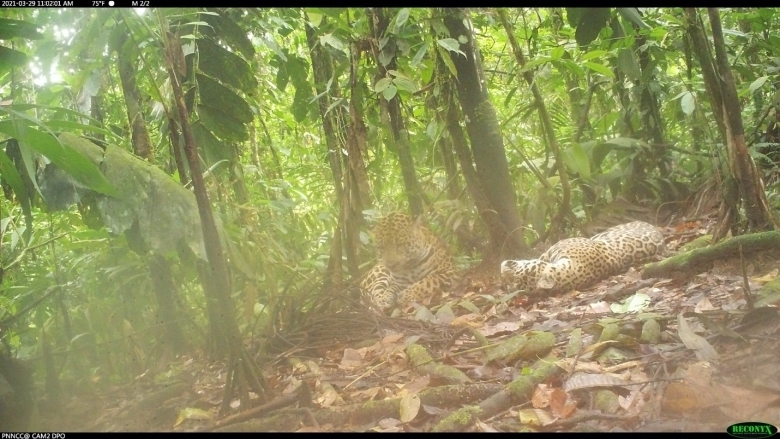
The project in Belize is securing and maintaining three functional, but threatened, biodiversity corridors, each with significant populations of jaguars. This landscape is considered critical to maintaining connectivity for jaguars in Mexico, Guatemala, and Honduras. The project executed by the Forest Department, Ministry of Fisheries, Forestry, the Environment and Sustainable Development in partnership with the United Nations Development Program (UNDP) is expanding camera trapping to monitor jaguars and their prey. This data will be used to strengthen enforcement efforts and create management plans for vulnerable habitats. To support coordination, the project will implement a standardized and centralized system of data management, with detailed systems for sharing data among contributing partner organizations. At the local level, the project is also enabling landowners to participate in conservation practices as citizen scientists, such as contributors to the national camera trap network.
- lp-body-content
- lp-body-content
Engaging cattle ranchers to mitigate human-jaguar conflict
Panama is one of the most crucial migratory routes in the Western Hemisphere. The GWP project executed by the Ministry of Environment and the Yaguara Panama Foundation in partnership with UNEP aims to mitigate human-jaguar conflict in and around Chagres National Park–Darien National Park Complex. An innovative aspect of the project is to work with six cattle ranches in the project site to demonstrate cost-effective human-wildlife conflict (HWC) prevention measures and generate proof of concept of jaguar-livestock coexistence in productive landscapes. To do so, the project will help cattle ranches adopt sustainable management plans that include site-specific anti-predation measures such as electric fences, fodder and protein banks, safe conditions and areas for maternity and calf raising, fencing wooded areas, pasture management, and health management. In addition, the project will support the first National Census of Jaguar and Terrestrial Mammals. This pioneering effort would enable the integration of jaguar data in three protected area management plans and support activities on HWC and connectivity management.
- lp-body-content
- lp-body-content
In the Ecuadorian Amazon, the project executed by the Ministry of Environment, Water and Ecological Transition and the Wildlife Conservation Society (WCS) in partnership with UNDP, is carrying out a jaguar census to inform local and national-level conservation actions to reduce threats over the jaguar. The project will also focus on reducing jaguar-human conflict within three prioritized landscapes. Additionally, the project will strengthen the capacity of law enforcement officials to detect, control, and dismantle trafficking in wildlife and it will facilitate inter-agency coordination by establishing a working group. To fill the gaps in data, the project will undertake research on wildlife crime (hunting, trafficking, and trade) related to jaguars and put together communication initiatives that increase awareness of the public on the importance of jaguar conservation. These include the educational campaigns of "Jaguars Forever" and the campaign to combat trafficking "if you take one, there will be none", recommending concrete actions for the local population to support wildlife conservation at the landscape level.
A common thread in all of these projects is the importance of ensuring coordination, maintaining connectivity, and promoting coexistence. Together, these three components can help offer the protection the jaguar needs if it is to survive and thrive.
- lp-body-content