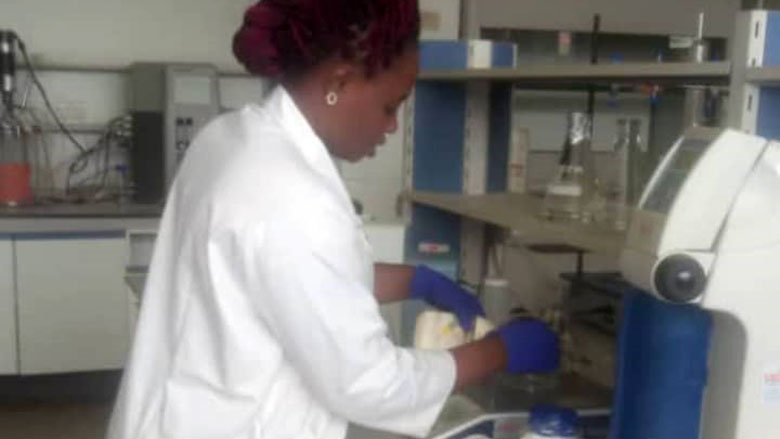
Linda’s research studied the effect of polymer waste into the mechanical properties of ceramic tiles using African clay. Most of Cameroon’s ceramic tiles are imported and local producers are few and far between. Having seen her uncle’s business collapse after his death, Linda was committed to exploring how more of these tiles could be produced in her country.
Inspired by a fellow student, Linda began to think about the environmental impact she could have. Sachet water, also known as pure water, is very popular among Nigerians. It is aimed at providing hygienic and affordable instant drinking water to the public.
“Once you step out of the campus, everything is littered with pure water sachets. So, I thought I could add it into my ceramic tiles.” The MSc program was intense. Linda remembers going home after classes and working late into the night on assignments and group presentations.
Linda working with ceramics in the lab during her Masters studies. Photo: Linda
But the “awesome environment” she found at the Center made it an excellent experience overall. With classmates from across West and Central Africa (and a Nigerian roommate), Linda was able to make the transition to living in a new country. “Having people from different cultures, with different pronunciations. Sometimes we would just laugh at one another. It was a real, collaborative, interactive experience. Despite the different areas of study, all of us were like one on campus.”
Making impact in her community
Linda is currently studying a doctorate at Nelson Mandela African Institution of Science and Technology in Arusha, Tanzania. In a deliberate move, she has now switched her focus to natural sciences. Personal tragedy has shaped Linda’s decision-making and strengthened her commitment to make an impact in her village and community.
“I had a cousin who died from cholera due to poor drinking water, now I know I’ve established something, the ceramic tiles, that I can take back to Cameroon. But I also now need to see how I can further help society.”
Linda’s doctoral research focuses on using natural ingredients, such as moringa and activated carbon, to improve water purification. She is due to complete her studies in 2023-24 and is very proud of her accomplishments, despite the challenges.
“My mom just called me and said, do you remember how people kept saying I shouldn’t allow you to finish school? In the African tradition, you have to get married, to give birth to children. That is still a big challenge for me. Everyone in my family is concerned.”
While this can sometimes make her feel a bit down, Linda is resolute in her determination to help others. “There are people out there who need to be helped. I won’t live my life just for myself. I will live it for others around me.”
Linda and her mother, a great inspiration. Photo: Linda
Women in science: Never stop going forward!
To other young African women who are thinking about pursuing scientific or technical degrees, Linda’s advice is to simply “just keep going”.
“People think science is only for very intelligent people. Once you start growing and they tell you, oh math is difficult, chemistry is difficult, keep studying. Keep reading that thing you don’t understand. It is the many times you read that thing that will make you understand.
“Failing doesn’t stop you from going forward. Never give up on yourself. The way the culture in Africa is changing, you need to study. You need to move forward.”