• English
  • Español
  • Français
  • عربي
  • Русский
  • 中文
The World Bank Working for a World Free of Poverty
GO
Home
  • ABOUT
  • DATA
  • RESEARCH
  • LEARNING
  • NEWS
  • PROJECTS & OPERATIONS
  • PUBLICATIONS
  • COUNTRIES
  • TOPICS

Chile

Show
country at a glance
Chile
Population 17,269,525 2011
GDP $248,585,499,941 2011
GDP growth 5.9%2011
Inflation 3.3%2011
More Data »

The first South American country to join the OCDE, Chile is one to the fastest growing Latin American economies. But despite making considerable progress in reducing poverty, inequality is still a massive challenge needing to be faced. Read More »

  • Context
  • Strategy
  • Results
  • Chile Home
  • Overview
  • Projects & Programs
  • Data
  • Research
  • News & Views
Country Office Contacts
CHILE +562 654-1065

Dag Hammarskjod 3241, Vitacura, Santiago
sarzubiaga@worldbank.org

USA +1 202 473-1000

1818 H Street NW, Washington, DC 20433
sarzubiaga@worldbank.org

RSS

Subscribe to the Bank's e-mail and RSS updates for work in Chile

  • Sign up for email updates »

  • Subscribe Now »
This page in:
  • English
  • Español
  • Print
  • Email
  • Facebook
  • Tweet
    • LinkedInLinkedIn
    • DiggDigg
    • 人人网人人网
    • Stumble UponStumble Upon
    • DeliciousDelicious
    • 新浪微博新浪微博

Chile Overview

  • Context
  • Strategy
  • Results

Two decades ago, Chile made the commitment to advance economic reform, proactive social investments, transparent public sector management and stable consensual governance.

In 2011, the government proposed seven structural reforms of Health and Education, Poverty and Crime Reduction, and reforming the state, political and environmental systems.

Chile is one of Latin America’s fastest growing economies. During the past 20 years, the country recorded an average annual per capita growth of 3.8 % and per capita income almost doubled in real terms.

Chile has consolidated macroeconomic stability by adopting a floating exchange rate, the establishment of strict inflation targets and fiscal discipline.

The country’s financial system is large and well-diversified compared with other countries in the region. It has a solid regulatory and supervisory framework, as well as the capacity for recovery in the event of crises.

During the second half of 2008, growth decelerated as global demand for Chilean exports declined and the terms of exchange deteriorated. Real GDP growth was -1% in 2009.

A strong fiscal stimulus package, financed with the savings accumulated during years of high copper prices, combined with a flexible monetary policy, supported an early economic recovery beginning in the last quarter of 2009. In January 2010, Chile became the first South American country to join the OECD.

Nevertheless, the devastating earthquake of February 2010 led to a -3.1% contraction in the first quarter of 2010. However, the economy rebounded vigorously, recording a growth of 6.1% in 2010, driven by reconstruction and investment.

Chile faces two challenges: enhance productivity and achieve equality of opportunities. Chile's growth slowed from an average of 7.6% in 1986-1997 to 4.3% in 2000-2009. In addition, productivity growth and investment levels experienced a downward trend throughout the past decade.

The second challenge is the need to tackle inequality. While Chile has made substantial progress in reducing poverty (15% in 2009), the average income of the richest 20% was 13 times that of the poorest 20% in 2009. Although Chile has actively invested in social protection programs, middle- and low-income households remain vulnerable to crises.

The Government of Chile has launched an ambitious development agenda to support the country's ultimate goal of achieving high-income developed status by 2018. The government plans to emphasize three strategic areas during 2010-2014:

  • achieving greater competitiveness, including the modernization of the state; 
  • increasing job creation and improving job quality; and 
  • promoting investment.

Moreover, the government is also committed to strengthen social policies and protect the environment.

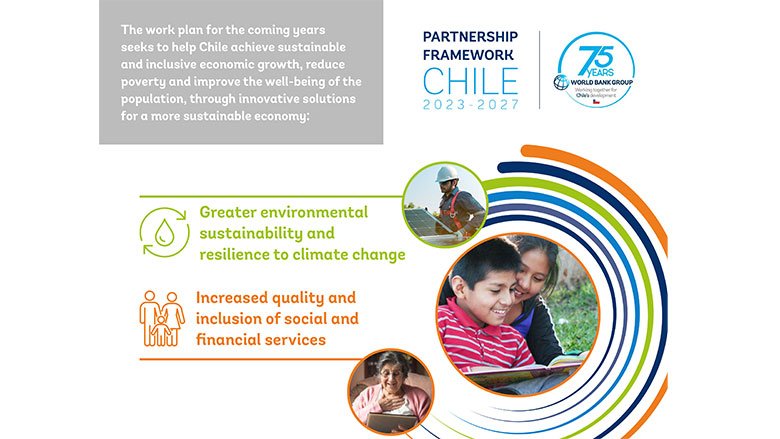
The Country Partnership Strategy (CPS) for 2011-2016 builds on the successful experience of the prior World Bank strategy in Chile. The strong institutional framework, a stable economy and the relatively advanced development level facilitate an engagement in which the Bank’s added value lies mainly in the knowledge agenda.

In a context of low financing needs and abundant access to capital markets at low spreads, Chile’s demand for Bank services concentrated on the provision of technical assistance and other knowledge products in areas in which the Bank has a comparative advantage and can support the country’s drive to achieve its development goals. This is an important two-way investment for the Bank given that Chile’s development experiences of the past decades are highly valued among other clients and continued engagement should allow for important spillovers into the Bank’s work in other countries, as well as stronger south-south cooperation.

This CPS aims to support the Government of Chile's vision of eradicating extreme poverty by 2014 and becoming a developed country by the end of the decade. This support will be carried out through focused interventions in specific themes that have been distributed into three results areas that broadly coincide with the government's development agenda:

  • public sector modernization,
  • job creation and equity improvement, and
  • promotion of sustainable investments.

The CPS covers six years and includes a flexible program to be carried out mainly through demand-driven studies and a small lending and grant portfolio. The bulk of the knowledge work will be delivered through studies structured around a Joint Studies Program funded by the Bank (US$400,000 per year) and the Government of Chile (up to US$800,000 annually), with the possibility of additional timely assistance through fee-for-service. In addition, the Bank will continue providing some limited financing for projects where the Bank’s support adds value in policy implementation in selected areas.

The main objective of support from the International Finance Corporation (IFC) will be to foster entrepreneurship in advanced fields or to develop innovative business models in a narrow range of sectors. Initially, investments will target tertiary education, vocational training, infrastructure, energy and financial services.


Highlights of the World Bank’s project portfolio in Chile include:

Ministry of Public Works Institutional Strengthening: This loan for US$11.7 million seeks to help the government achieve sustainable, comprehensive planning of infrastructure at the national and regional levels. Activities include use of contracts and standards to increase the efficiency of investments and the strengthening of  regulatory policies. 

Public Expenditure Management: The second project of this type, funded with a US$ 24.8 million loan, aims to increase the efficiency of operations associated with financial management and budget formulation and implementation, as well as transparency of central and municipal government finances, through the updating, expansion and improvement of the Government Financial Management Information System (SIGFE).

Tertiary Education Finance for Results, funded with a US$ 40 million loan, seeks to improve quality and relevance for students in tertiary education in an effort to continue developing the country’s human capital.

Rural Infrastructure for Territorial Development: The IBRD invested US$ 50.3 million for the preparation of land development plans for 75 territories through a highly participatory local effort that complements current priorities of the Ministry of Planning and Cooperation for sustainable service infrastructure in rural communities.

The Bank has provided broad support to Chile, from the assessment of options for the next generation of environmental institutions and policies, to funding by the Global Environment Facility (GEF), the Montreal Protocol and carbon markets for land degradation prevention, biodiversity conservation, renewable energy (including three small hydroelectric projects in Chacabuquito, Quilleco and Hornitos), climate change mitigation and implementation of the Montreal Protocol on ozone-depleting substances.

The Agricultural Innovation System: An Action Plan towards 2030:  This study proposes a broad, shared vision on the future of the rural economy, food and forestry production as the basis for defining the mid- and long-term strategy for integrated value chains.

The Decentralization Agenda in Chile (sp): This study analyzes the transfer of education and health responsibilities to municipalities and makes recommendations for improving the decentralization of these sectors and other responsibilities to the local level.

Water Resources Management Assessment (sp): Water has become the strategic resource of the twenty-first century and water reserves are being registered throughout the world, including Chile. This study, conducted by the Water Directorate (DGA) and the World Bank, analyzes the management of this resource in the country.

In the knowledge-sharing arena, the World Bank and the OECD published a review of tertiary education in 2009, Reviews of National Polices for Education - Tertiary Education in Chile. While in 2010, a team from both organizations carried out a review of Chile’s International Scholarship Program. And in 2011, the World Bank assessed the effectiveness of the State Guaranteed Student Loan Program (CAE). Throughout this period, the World Bank has based its analytical work on higher education in Latin America and other regions, and on the collective knowledge gathered by the Thematic Group on Tertiary Education (COREHEG).


RELATED
  • Country Partnership Strategy

Chile : Lending By Volume (Millions Of US Dollars)

Around The Bank Group

Find out what the Bank Group's branches are doing in Chile

  • IFC
  • MIGA
You are here
  • Countries
  • /
  • Chile Home
  • /
  • Overview
ABOUT
  • Mission
  • History
  • Leadership
  • Organization & Affiliates
  • Public Outreach
  • Events
  • People
  • Jobs
  • Annual Reports
DATA
  • Search Data
  • DataBank
  • Catalog
  • Data Publications & Products
  • APIs For Developers
RESEARCH
  • Search Research
  • Tools & Tables
  • Research Publications & Products
LEARNING
  • Global Development Learning Network
  • Capacity Development Resource Center
  • Statistical Capacity Building
  • Scholarships & Fellowships
NEWS
  • Search for News
  • Blogs
  • Multimedia
  • Media Briefing Center
  • Media Contacts
PROJECTS & OPERATIONS
  • Search Projects
  • Our Focus
  • Products & Services
  • Projects
  • Country Lending
  • Procurement
  • Evaluation
  • Results
PUBLICATIONS
  • Bookstore
  • Documents & Reports
  • Archives
  • Libraries
COUNTRIES
TOPICS
RESOURCES FOR
  • Civil Society
  • Parliamentarians
  • Investors
  • Journalists
  • Students & Teachers
The World Bank Group
IBRD IDA IFC MIGA ICSID

Legal | Site Map | Jobs | Contact
© The World Bank Group, All Rights Reserved.

Fraud & Corruption Hotline
1-800-831-0463