00:06 Small and medium enterprises are the backbone of
00:10 the economy in the Western Balkans region.
00:12 One of the key challenges that these companies face
00:16 is lack of market traction,
00:17 which makes there being a proposition less attractive to potential investors.
00:22 Uh,
00:22 Nasha firmo sebavi malorodeounhi chocola nibola,
00:29 uh,
00:30 posit,
00:30 uh,
00:30 director of Oyneastic,
00:32 uh,
00:32 navicheses of your provoocheat.
00:36 Slow digitalization presents several obstacles
00:48 in promising Western Balkan market.
00:50 For example,
00:52 in Montenegro,
00:54 there are certain restrictions in onboarding clients online,
00:57 and I hope in the future we can
00:59 all work together to change these obsolete practices and
01:04 set up the foundation for regional business growth.
01:08 Exporting to larger and richer countries provides a potential solution,
01:12 but expanding into foreign markets involves considerable search barriers,
01:16 and small and medium enterprises may lack the knowledge,
01:19 the skills,
01:20 and the confidence to try to do so.
01:22 Policymakers can reap important returns for their
01:24 country by making these companies investment ready.
01:51 We applied
01:52 and we were selected in the shortlist.
01:55 We offer instant real-time payments
01:58 and money transfer.
02:00 We do offer
02:02 these payments to all the population.
02:05 We offer even to the unbanked,
02:07 and this is very important,
02:08 knowing that Albania has a high percentage of unbanked.
02:13 We can offer now these kind of innovative products
02:18 to every customer in Albania either being banked or unbanked.
03:21 Power Up led us to this idea
03:24 to transfer something analog to a digital product
03:28 bought inside our app,
03:30 reaching
03:31 wider markets where
03:33 IT has the dominant position.
03:36 So that was the thing that led us
03:40 to a decision to
03:42 create our own app,
03:44 to
03:45 invest in machines that are going to be working with that app.
03:53 Uh,
03:53 we should care about these programs because,
03:55 uh,
03:55 these programs help firms actually to get access to external sources of funding,
04:00 basically to grow.
04:01 This type of programs increase firm profitability,
04:04 which is an important source of economic growth and job creation.
04:08 Startup company.
04:34 We currently have 47 employees in our team.
04:38 At the same time,
04:40 we operate through more than 500 agents all around Albania.
04:59 To the young people from Western Balkans,
05:02 I would send a message that everything is possible.
05:09 Comparing with the period I started my own business,
05:13 it's a huge difference.
05:14 So we are already part of the revolution.
05:17 It's the right time.
05:19 Just do it.
- lp-body-content
- first-letter
The Western Balkans are an innovation hub. When the World Bank and the European Union partnered in 2020 to bolster small and innovative Western Balkan companies’ investment readiness, the idea was to help them expand their market beyond national borders with intensive in-person mentoring and tailored trainings.
As the pandemic drastically constrained global economic activity, some of the companies saw the program as a lifeline through the period of lockdowns and collapsing sales. For others, the program was an eye-opener, leading to new digital solutions which broadened their client base and expanded sales. The activity included innovative and revenue-generating small and medium enterprises from Albania, Bosnia and Herzegovina, Kosovo, Montenegro, North Macedonia, and Serbia.
“Investors often look for company leaders who are ‘coachable,’" said Maja Andjelkovic, World Bank Senior Private Sector Specialist. “This training program showed that innovative firms from the Western Balkans are not only keen to learn, but also able to quickly apply new knowledge to adapt to demand shocks, such as those caused by the COVID-19 pandemic.”
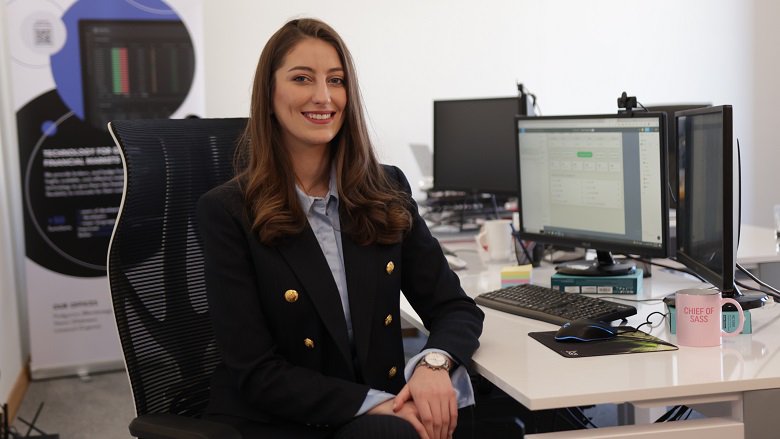
Marija Bojović is the marketing manager at EAERA, a fintech consultancy headquartered in Podgorica, Montenegro
Good Intentions, Mixed Outcomes
The pandemic reshaped both the format and the content of the planned trainings and assistance, shifting focus to boosting digital marketing skills in highly uncertain times. The goal throughout the trainings remained to encourage participating companies to adopt a more agile approach in consolidating and expanding their domestic and foreign customer base.
Participating companies came from different industries, mostly in services and B2B, as well as e-commerce and manufacturing. As many as 71% of them were exporting already.
Of 225 companies selected for the program, 113 were assigned to a treatment group, gaining more in-depth training on building a customer base and new markets, using digital marketing tools, and receiving advice on human resources, financial management, and pitching their products to potential investors. A control group of 112 firms received a compact version of trainings.
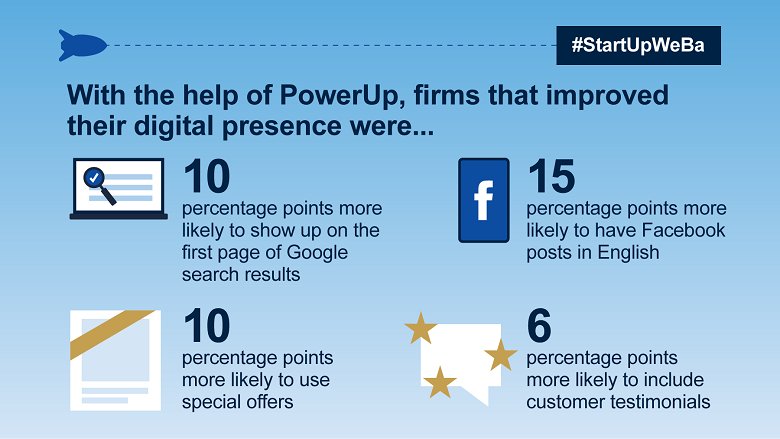
Firms in the treatment group improved their digital presence in a way that made it easier for potential international customers to find the firm’s offerings and be attracted to contact the firm. Treated firms were also 10 percentage points more likely to show up on the first page of search results and improved their Facebook pages by being 15 percentage points more likely to include posts in English, 10 percentage points more likely to use special offers, and 6 percentage points more likely to include customer testimonials and stories. A year after starting the program, treated firms had also significantly increased the number of customers.
Outcomes appear to have been most positive for firms coming from an ICT sector, where even some light training to acquire or polish digital marketing skills, revamp websites, or turn to social media channels had led to good results.
“The Economic and Investment Plan and the Innovation Agenda for the Western Balkans emphasize the importance to strengthen the competitiveness of the business sector in the region and to promote innovation ecosystems,” said Holger Schröder, Head of Unit, Western Balkans Regional Programmes and Economic and Investment Plan, European Commission, Directorate General for Neighbourhood and Enlargement Negotiations. “The Power-Up study identifies approaches how SMEs can build up their capacity to change and resilience to crisis through innovation and digitalization. The study also demonstrates the positive impact and benefits of virtual training to firms with different needs at regional level.”
From Brick & Mortar to Digital
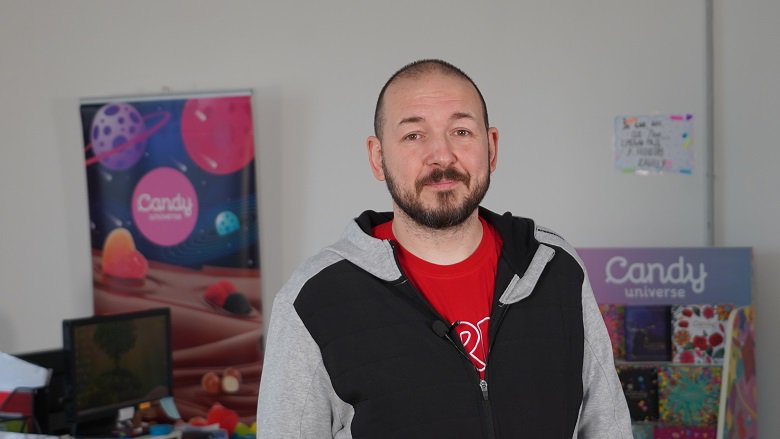
For a producer of non-essential luxury, the pandemic was a shock to business. Boris and Sanja Pezelj, a married couple who founded Candy Universe, a small but thriving business of making gummy and chocolate candies that relied on sales in brick-and-mortar spaces, predominantly shopping malls, the pandemic meant a total change of their idea of how to operate in challenging times. The only way forward was to start building an online presence.
"One of the reasons we joined PowerUp was to find an investor who can help us expand to markets around us,’’ says Boris Pezelj. "We failed to do that not only because of our offer to investors but because of the whole idea of scaling and reaching wider markets, where IT has a dominant position. So that was the thing that led us to a decision to create our own app, to invest in machines that are going to be working with that app and enter the IT sector of the business.’’ A little more than one year later, Candy Universe is on the verge of launching its own app.
Simple Advice, Significant Impact
Examples of how the program worked are many. A Bosnian company selling specialized safety equipment was not using search engine optimization before the program. But it also welcomed advice how to reach regional do-it-yourself retail chains. Another Bosnian company making baby-carriers followed the advice to turn more to social media but also to consider opening a storage location in neighboring Croatia as a potential steppingstone to EU markets.
Arel Neuromarketing – the first integrated neuromarketing laboratory in North Macedonia and one of the 10 finalists of the PowerUp program – has already been combining advanced techniques of neuroscience, psychology, and marketing to take the communication between brands and consumers to a new level. For Jasna Stoimirovska Velichkov, the founder, the PowerUp program was a chance to learn to attract new buyers, develop better business models, and seek investment. But it was also about networking. "We were very much interested in the networking opportunities to connect with other companies in the Western Balkans and see what they are up to and see how they are doing business in this environment.’’
Networking mattered a lot to Erdal Corbo, the founder and director of Kamen dizajn, a Bosnian company producing stone and marble from concrete. Joint online sessions allowed Corbo to connect with companies from the region at a time when visiting fairs was not an option due to widespread pandemic-related travel restrictions and lockdowns. Corbo said the training was a refresher. ``The lessons from the PowerUp program helped me to take a more structured approach to analyzing key business data, and that helped me later in organizing my work.’’
Erdal Corbo, the founder and director of Kamen dizajn, a Bosnian company producing stone and marble from concrete
Going Forward
The PowerUp program followed another joint World Bank and the European Union effort to help small and young, innovative entrepreneurs learn about equity investment opportunities and pitching skills, as well as seek out assistance during an earlier stage of product development, even before generating revenue. These programs aim to help innovative startups and SMEs make their ideas attractive to outside funding and eventually reach customers. Many entrepreneurs participating in the program said they’d do it again if a new round would be available.
“With close proximity to the European single market and important trade routes, the Western Balkans have the potential to become a natural hub for innovation and entrepreneurship,” said Xiaoqing Yu, World Bank Country Director for the Western Balkans. “A program such as PowerUp demonstrates to investors and business owners the significant growth potential SMEs can unlock when they improve skills required to expand their sales across national borders. It also shows citizens who may be considering starting a business that success is possible and that they do not have to go it alone.”
RELATED
- lp-body-content
- first-letter