- font-medium
- bg_blue_05
STORY HIGHLIGHTS
- Malawi’s GDP growth per capita has been low, averaging 1.5 % per year between 2010 and 2019 with minimal impact to reduce poverty.
- For every three Malawians that moved out of poverty be¬tween 2010 and 2019, four fell back in due to the impact of weather shocks.
- Within a year, the average household allocates around 230 hours of work to agriculture, equivalent of one month of labor.
- lp-body-content
- first-letter
LILONGWE - November 8, 2022- The marks of continued poverty in households in Malawi are clearly visible. Access to basic needs remains challenging and the struggle to fend for the day is the usual for many. About half the population of 19.1 million people in Malawi live in poverty, and nearly three-quarters live on less than $1.90 per day. Poverty distribution is not uniformly grim of course, because the northern region part of Malawi has achieved some reductions in poverty over the past ten years compared to the central and southern regions.
The Malawi Poverty Assessment report Poverty Persistence in Malawi: Climate Shocks, Low Agricultural Productivity, shows slow structural transformation of poverty reduction. In the last decade, while some people escaped poverty, others fell into poverty, in part due to recurring climate shocks.
In Malawi, the proportion of people living on less than $1.90 a day is 73 %, the second highest rate among the poorest countries of Sub-Saharan Africa in 2020.Around 94% of poor Malawians live in rural areas.
This proportion of people living in poverty has not changed in over a decade such that in 2019, Malawi’s poverty rate was 50.7%. With an average annual population growth of 2.8%, the absolute number of poor increased by 2 million over ten years.
During this period, GDP growth per capita has been low, averaging 1.5% per year and has done very little to reduce poverty.
Malawi’s reliance on agriculture for economic growth has not helped to lift many out of poverty either because between 2010 and 2019, the contribution of agriculture as the main source of income of a household declined from 70% to below 50%. In 2010, 56% of people received income only from agriculture while in 2019, this proportion fell to 29%.
The slow movement out of poverty compounded by climate shocks
For every three Malawians that moved out of poverty between 2010 and 2019, four fell back in due to the impact of weather shocks. Around 60% of individuals in Malawi experienced at least one episode of poverty either in 2010, 2019 or in both years, demonstrating the persistence of poverty.
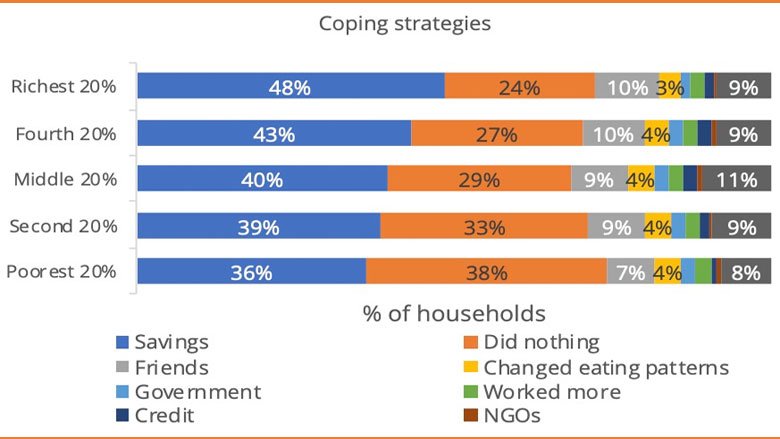
Household's Source of Support After Suffering a Climate Shock
Among all individuals observed in 2010, the report finds that, while 15% moved out of poverty by 2019, 18% moved into poverty and 30% remained poor. People who escaped poverty included those who moved from agriculture into ganyu, household businesses, and salaried employment, and those that improved their levels of education. Conversely, those who fell into poverty were households in higher-return activities that switched back to agriculture.
Data from the household survey shows that the probability of a household being poor increases by 14 percentage points after experiencing a climate shock and that household income from agriculture decreases 17 percentage points after a flood and 14 percentage points after a drought.
In addition, the lack of access to markets constrains the establishment and growth of businesses. Low levels of education and lack of training and skills also affect the survival of businesses. Half of all new businesses are not observed in operation in a given month during the first year of operation, especially if the owner doesn’t have an education certificate or if is a woman.
Women are affected more
Women, according to the report, face disproportionate drawbacks accessing inputs and resources, affecting their performance in different economic activities. In addition, female productivity in agriculture is lower than for men, mainly due to differences in the use of inputs, the smaller size of land women have access to and the fewer farm assets they own. Time allocated to productive activities like agriculture is lower than for men due to a high share of their time allocated to domestic duties, and care-giving work. Similarly, in the presence of low access to electricity and water, women also tend to spend more time than men collecting firewood and water.
With fewer women having access to financial services for their households’ business than men and only 30% of women having a bank account (compared to 38% of men, the average female-headed household borrows more frequently at high interest rates, from village banks and money lenders.
Exploring policy options to address poverty challenges
The report proposes the following policy options:
- Improving livelihood options for the poor, both in the agriculture sector where most of the poor currently work and in other sectors.
- Improving non-farm employment options, for example by redoubling on-going government efforts to support the private sector to create jobs and move labor out of agriculture and incentivize rural-urban migration.
- Addressing determinants of unequal opportunity, especially low completion rates for secondary education, by helping families to alleviate financial constraints that drive their children out of the school system.
- Redirecting or adapting existing social programs to target households that are highly exposed to climate shocks.
RELATED
- lp-body-content
- first-letter