col-xs-12
col-sm-12
col-md-1
col-lg-1
col-xs-12
col-sm-12
col-md-10
col-lg-10
col-xs-12
col-sm-12
col-md-1
col-lg-1
col-xs-12
col-sm-12
col-md-12
col-lg-12
Photo: © Erick Kaglan/World Bank
col-xs-12
col-sm-12
col-md-3
col-lg-3
col-xs-12
col-sm-12
col-md-7
col-lg-7
  • font-medium
  • bg_blue_05

Key numbers

  • 90 Africa Centers of Excellence have been established across 20 countries and have supported over 25,000 Masters and PhD students
  • The share of female students increased to 38 percent
col-xs-12
col-sm-12
col-md-2
col-lg-2
col-xs-12
col-sm-12
col-md-3
col-lg-3
col-xs-12
col-sm-12
col-md-7
col-lg-7
  • lp-body-content
  • first-letter

Cyprian Syeunda graduated with a Master of Science in Food Science and Technology from Kenya’s Centre of Excellence in Sustainable Agriculture & Agribusiness Management—and did so with flying colors. Named “Best Master’s Student,” he has already published in an internationally reputed journal. His next stop is Texas A&M State University, where he has won a scholarship to pursue a PhD in Food Science and Nutrition.

“We share in this excellence and grateful for the World Bank funding that has made this possible,” says Cyprian. “If it were without the support, probably I would not have made it to this level.”

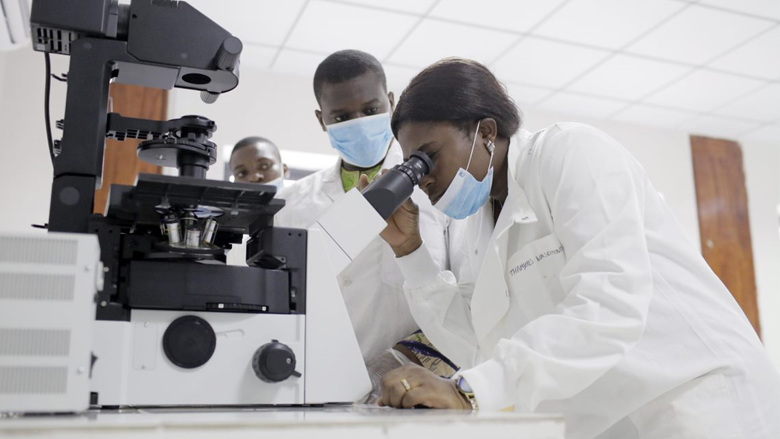
Cyprian has benefitted from the IDA-supported Eastern & Southern Africa Higher Education Centers of Excellence (ACEII) project. The project is designed to strengthen selected academic research centers to deliver quality post-graduate education and develop globally engaged and collaborative research capacity in the Eastern and Southern Africa region.

The project addresses the fact that the countries of Eastern and Southern Africa have not produced the quantity and quality of skilled graduates required for expanding and diversifying their economies. Despite an uptick in university enrollments over the last two decades, the region has lagged behind others in developing graduates in disciplines related to science, technology, engineering and mathematics—as well as in applying high-quality research to address local issues.

Female enrollment rates—as a percent of total enrollment—were particularly low: less than one percent in Malawi and four percent in Ethiopia.

videoType
you-tube
videoUrl
pSQs-8GWfCM
title
Africa Higher Education Fair Connects Schools and Students
keyFrameImage
https://i.ytimg.com/vi/pSQs-8GWfCM/maxresdefault.jpg
description
: The first edition of the African Higher Education Fair, held on the campus of the International Institute of Water and Environment Engineering 2IE in Ouagadougou Burkina Faso, brought together 22 African Centers of Excellence from nine West African countries. These centers came to present their training and research programs to students and professionals planning further university studies. Each of the 22 centers of excellence is regionally unique. They seek to produce a critical mass of high-level specialists at the Masters and PhD levels as well as providing short term professional training to professionals seeking to improve their skills. The programs are focused on producing the skills needed to address regional development challenges in areas such as water, agriculture, health, technology, engineering and mathematics. The African Centers of Excellence initiative is a flagship program supported by the World Bank that is providing an innovative regional response to make higher education more relevant to Africa’s development.
showTimestampAndTranscript
no
duration
293
lastUploadedDate
2019-01-10T22:13:22Z

The ACEII project seeks to share innovations and good practices in teaching and learning, and to enhance cross-border research networks. The project is also building capacity to address key institutional inadequacies, such as partnership development with the private sector and competitive scholarships.

Special attention is also paid to developing the capacity of promising female scholars; for example, by encouraging them to study in an Africa Centers of Excellence (ACE) institution outside their native country in the region.

Between 2014 and 2020, more than 90 ACE were established across 20 countries and have supported over 25,000 Masters and PhD students, under international standards and modern teaching conditions. Notably, the share of female students gradually increased from 27 percent to 38 percent. Under the ACE Scholarship Program, 60 regional female students have been financed for two years to attain a Master’s degree at any of the ACEs.

ACEII also helped to forge university partnerships to improve the quality of teaching, research and innovation. For example, study tours were conducted and multiple partnerships developed with Chinese, Japanese and Indian universities.

Agreements were also established with universities in Europe, the United States, Korea and other African countries to facilitate student exchanges, joint research, and international accreditation.

Financial and programmatic sustainability have been primary considerations during implementation, notably by building in results-based financing. ACEII matches $1 for every $1 raised from national sources, and $2 for every $1 raised from regional and international sources. A total of $21 million has been raised by the ACEs so far. Through this, the ACEs are developing the skills to compete for research and other external funding opportunities to finance their development needs.

lp-heading-top-medium
lp-heading-bottom-medium
col-xs-12
col-sm-12
col-md-2
col-lg-2
  • lp-body-content
  • first-letter