
- add-style
- lp-body-content
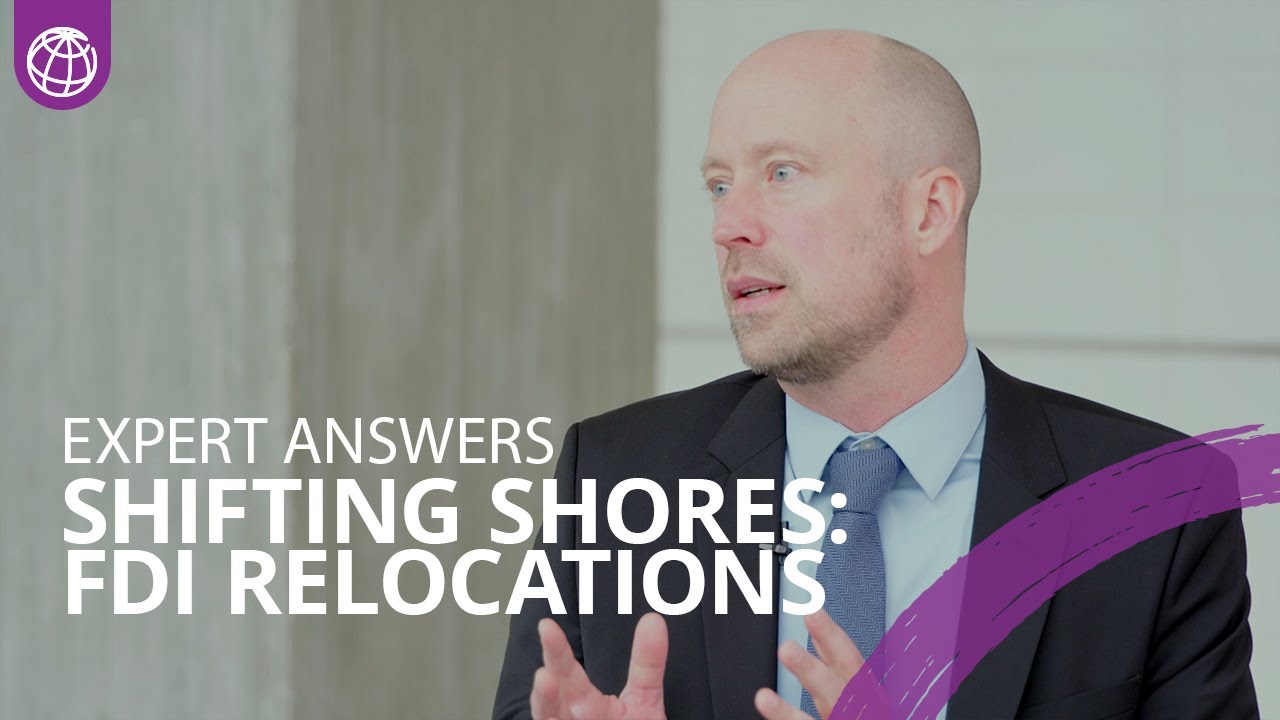
Foreign Direct Investment (FDI) has powered prosperity in development for decades. But in recent years FDI flows have been impacted by overlapping crises, including the pandemic, increasing geopolitical fragmentation, and slower world economic growth. This has led to new patterns in FDI, analyzed in a recent MIGA report “Shifting Shores: FDI Relocations and Political Risk.”
Moritz Nebe, Sector Manager at the Multilateral Investment Guarantee Agency which houses the World Bank Group Guarantee Platform, joins Expert Answers to unpack what these changes mean for investors and the developing world.
Timestamps
00:00 Welcome
01:31 About Foreign Direct Investment (FDI)
03:20 Shifting Shores: FDI relocations and political risk
06:12 Responding to the shifts
Transcript
[00:00] - Ultimately, investors are looking to make their investments more secure, more stable, more predictable.
- Today on "Expert Answers," we're looking at something that has powered prosperity and development for decades. It has provided financial resources for a range of projects, from water treatment plants and power stations to hospitals. We're talking Foreign Direct Investment, FDI for short. It has been a reliable contributor to economic growth, driving technology transfer and innovation across the world. FDI has helped the developing world move forward, and supporting impactful FDI is a key part of the World Bank Group's work. The Multilateral Investment Guarantee Agency, or MIGA for short, supports such developmentally impactful FDI in client countries by de-risking investment through guarantees for private investors. MIGA is also the home of the new World Bank Group Guarantee Platform, which provides many types of guarantees. But in recent years, FDI flows have been impacted by overlapping crises, including the pandemic, increasing geopolitical fragmentation, and a slower world economic growth. This has led to new patterns in FDI analyzed in a recent MIGA report, Shifting Shores: FDI Relocations and Political Risk. Let's find out more.
- I'm joined by Moritz Nebe, who is a sector manager with MIGA. Moritz, welcome to "Expert Answers."
- Thank you, Andrea.
[01:31] - Can you begin by telling us a little more about FDI and the forms investment can take?
- Thank you. FDI or Foreign Direct Investment, what it stands for, is essentially the long-term capital commitment by an investor or a company into a company or a business venture in a foreign country. That commitment is typically signified by at least a 10% ownership stake or more. Typically, we characterize investment into two categories. One is greenfield investments, the investment in a brand-new venture. It can be a manufacturing facility, a production facility. It can be an infrastructure asset. And the second category is what we call brownfield investment, which is the acquisition of an existing venture which is already producing, operating, and typically generating revenues for that investor as well. Let me give you an example for a greenfield investment which MIGA has recently supported through the provision of guarantees. MIGA provided the guarantee support to a foreign investor that invested in the development of solar in power plants in Egypt. Those power plants generate cheaper electricity in the country. They enhance energy security. They reduce pollution and harmful emissions in the country. An example for a brownfield project would be a high-voltage transmission line in Cambodia, where MIGA provided guarantee support to an investor who acquired that asset. It was already built and up and running. That new investor came with a long-term commitment as well as, importantly, stable financial backing to support the project in the long term.
[03:20] - Now let's talk about the most recent MIGA report titled Shifting Shores: FDI Relocations and Political Risk, which analyzes the shifting patterns in Foreign Direct Investment. So how is the FDI landscape changing and why?
- What the report does, it complements an analysis of historical data, including recent historical data from since the pandemic with a forward-looking view. We've conducted a survey with investment promotion agencies from across the world. These investment promotion agencies interact with foreign investors on a daily basis, and we see from investors that, indeed, their investment intentions are increasingly driven by new considerations which played a lesser role in the past. In particular, considerations about geopolitical developments in the world, as well as considerations about supply chain management and geographic proximity between the home country and host country. Ultimately, investors are looking to make their investments more secure, more stable, more predictable. Now, this phenomenon around taking into account geopolitical considerations much more in investment decisions is what is often termed friend-shoring, placing investments in countries that have a closer relationship politically speaking with the home country of the investor. And then we look at what's dubbed near-shoring, which is really the consideration around geographical proximity between the country of production and the home country of the investor, where often in the markets for finished goods are located as well. Over 80% of investment promotion agencies believe that the trends of near-shoring and friend-shoring will play a significant or very significant role for their countries going forward. What is also curious, that most investment promotion agencies believe that their countries are set to benefit from these trends. And that is an interesting observation. If we think about relocation of Foreign Direct Investment, see either relocation of existing businesses from one country into another country or we see that future investment decisions from foreign investors, where to put their capital to work, will benefit some countries, but other countries will be losing out. So we can think about this as something like a zero-sum game. Probably many more countries than currently anticipate will actually be on the losing end of these FDI relocations and that's an important consideration for international development to take into account.
[06:12] - And thinking about these countries that may experience challenges, how can developing countries respond to these shifts and how can institutions like the World Bank Group support them?
- Developing countries can continue to follow a tried and tested approach to attracting FDI and that is investing in their regulatory environment, in their operating environment, to make it more business friendly and more investor friendly. Institutions like the World Bank Group can provide significant assistance in that regard through technical assistance as well as policy advice to help countries create a more stable and more predictable macro environment for foreign investors. These considerations are particularly important for low-income countries, which are characterized in particular since the pandemic by significant debt overhang, by limited fiscal space, as well as, generally speaking, by weaker regulatory environment and less predictable operating environments for foreign investors. Another way that the World Bank Group can contribute to attracting Foreign Direct Investment is by the provision of political risk insurance, and MIGA, for example, can provide foreign investors with political risk insurance, can encourage host countries to facilitate investors coming in. What our survey and our reports show is that despite the availability of political risk insurance in the market, it's only a small portion of foreign investments that are currently supported by political risk insurance, and that's despite the fact that political risks are often high and, in many cases, are actually growing as we speak. What does that mean for the political risk insurance industry? More can be done to educate investors about the availability of political risk insurance and about the mechanics of how political risk insurance work, but also political risk insurance providers are called to the task to evolve their product offerings more, to make them more relevant and more specific to the current needs of foreign investors when they look to insure their foreign investments going forward.
- Well, thank you so much for such an insightful conversation, Moritz, and I hope to speak with you again.
- I thank you very much.
- So there you have it. The changing times in Foreign Direct Investment and how the World Bank Group's Multilateral Investment Guarantee Agency continues to support both investors and developing countries. If you want to find out more, check out the reports and resources section of the MIGA website. Thank you for watching "Expert Answers." See you soon.

ABOUT WORLD BANK EXPERT ANSWERS
Every episode of Expert Answers sits you down with a World Bank specialist: an expert answers with expert answers. From debt relief to gender equality. From COVID-19 response to inclusive growth, and much more. Our goal is to help you understand some of the biggest issues in international development today by asking our colleagues about what works on the ground and what we can do to meet the biggest global challenges. Watch previous episodes of Expert Answers!
ABOUT THE WORLD BANK
The World Bank is one of the world’s largest sources of funding and knowledge for low-income countries. Its five institutions share a commitment to reducing poverty, increasing shared prosperity, and promoting sustainable development.