For the latest information, please visit
Government Resources and Projections for Health Series (GRPH)
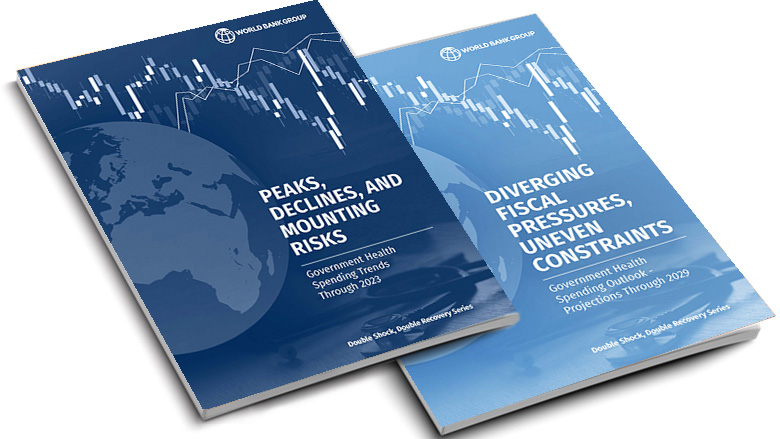
The reports reveal troubling trends across low-income countries (LICs) and lower middle-income countries (LMICs), exposing serious risks to the necessary growth of public investments in health. For many countries, achieving the SDG health targets is increasingly out of reach, underscoring the urgent need for decisive action to address mounting financing challenges. With these targets at risk, the World Bank Group remains committed to helping countries deliver quality, affordable health services to 1.5 billion people by 2030 as part of our global mission to ensure a basic standard of care throughout every stage of life.
For the latest information, please visit
Government Resources and Projections for Health Series (GRPH)
For the latest information, please visit
Government Resources and Projections for Health Series (GRPH)
As of November, 2024:
Health Spending Outlook -- Projections Through 2029: Diverging Fiscal Pressures, Uneven Constraints
For the latest information, please visit
Government Resources and Projections for Health Series (GRPH)
In 41 countries, government spending until 2027 is projected to remain lower than before COVID-19, restricting their ability to invest in critical areas, including health.
In 69 countries, government spending is expected to exceed 2019 levels, but the increases will be weak.
And in only 67 countries, government spending is projected to increase steadily through 2027.
With debt levels at record highs and interest rates rising to control inflation, many governments will struggle to meet interest payments on public debt.
Interest payments will constrain the capacity of low-income countries to spend on health on average by 7% and in lower middle-income countries by 10 % in 2027.
The impact of interest payments varies vastly across these countries, in some of them, they are expected to constrain their health spending capacity between 15-30% in 2027.
The projected decline of government spending in many low and lower-middle income countries will restrict their ability to strengthen pandemic preparedness and limit their progress towards universal health coverage.
This will lead to growing inequalities between countries, threatening global stability, and prosperity.
Governments need to increase revenues, give greater priority to health in budgets, and improve the efficiency and equity of health spending.
By increasing development aid and working towards comprehensive debt solutions for low- and lower middle-income countries, high-income countries can preempt emerging threats to peace and prosperity – securing a healthier, more secure future for all.
The “From Double Shock to Double Recovery” discussion paper series examines the latest trends and outlooks in government health spending, launched in response to intensifying macro-fiscal pressures and escalating development challenges initially triggered by the COVID-19 crisis. The series also explores policy options for countries aiming to secure sustainable financing pathways toward the health SDGs amid these ongoing challenges.
The first outlook was published in March 2021 at the height of the COVID-19 crisis and included a comprehensive review of health financing policies aimed at maintaining or increasing health investments during macroeconomic downturns. A technical update, “Widening Rifts,” followed in September 2021, and a second update, “Old Scars, New Wounds,” was released in September 2022.
The first review of recent spending trends, “Strong Advance, Early Retreat”, was published in June 2023 and provided a comprehensive analysis of government health spending trends in low- and lower-middle income countries during the pandemic response and early recovery phase from 2019 to 2022.


