Development of natural capital accounts, data, tools, and analyses
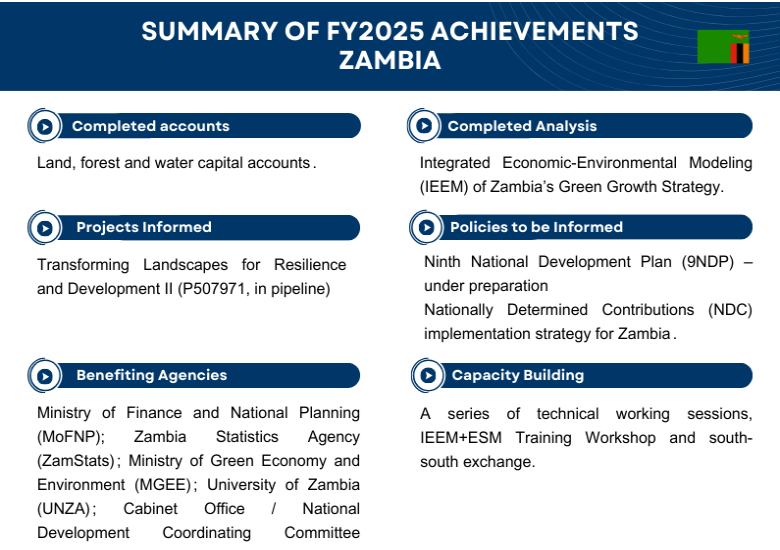
GPS has been supporting NCA activities in Zambia under the previous TTA project which provided the basis for the CIC activity to update the existing accounts. Accordingly, significant progress was made during FY25, with three updated and/or expanded natural capital accounts completed.
- The Land Account includes updated Land Use/Land Cover (LULC) maps and tables, which are linked to economic data from the 2019 Social Accounting Matrix (SAM).
- The Forest Account captures both provisioning and regulating services and is connected to emissions mitigation projections and poverty outcomes. The Water Account quantifies yield, quality, and usage at both national and provincial scales.
These updated accounts are built on previous work, and they are already being used within the government. These are expected to become publicly available for public use during FY26. The updated land, forest, and water accounts highlighted the dependence of rural and vulnerable populations on natural resources, particularly for livelihoods, fuelwood, and water — which are central to social inclusion and poverty reduction.
The Integrated Economic-Environmental Modeling plus ecosystem modeling (IEEM+ESM) was applied to analyze the macroeconomic and environmental implications of implementing Zambia’s Green Growth Strategy. The results from these nature-aware CGE modeling analyses have been shared with the Ministry of Finance. The modeling work focuses on macroeconomic, environmental, and biophysical outcomes, including GDP, national wealth, emissions reductions, ecosystem services, aggregate poverty headcount, and land-use changes. The modeling quantified poverty reduction effects of agriculture, forestry, and other land use (AFOLU) investments (lifting an estimated 7,100 people out of poverty by 2050), reflecting improved access to land and resources through nature-based solutions. The analysis also identified provincial disparities in forest loss, land degradation, and water stress, which relate to resource access and distributional issues between regions.
Informing investments and/or policies
The Zambia NCA Program directly informed the design of the Transforming Landscapes for Resilience and Development II (TRALARD II, P507971, in pipeline) investment. Specifically, GPS analytics and NCA outputs enabled TRALARD II to:
- Identify priority provinces and landscapes for investments in climate-smart agriculture, reforestation, and watershed management;
- Quantify expected GDP, poverty, and emissions outcomes of proposed investments; and
- Provide an evidence base for trade-off decisions between sectors and investment options in the TRALARD II Project Appraisal Document (PAD).
These analytics were acknowledged in the PAD and will help ensure that the planned operation targets areas with the greatest potential for climate adaptation and resilience impact.
On the policy side, the GPS grant has contributed to two policies:
- The Ninth National Development Plan (9NDP) of Zambia, currently under consultation, is the government’s main policy guide for the next five years. Updated land, forest, and water accounts, together with integrated economic-environmental modeling, provided evidence and scenarios supporting the 9NDP’s emphasis on green growth, climate resilience, and sustainable resource use. These analyses quantify how investments in climate-smart agriculture, reforestation, and watershed management contribute to GDP, national wealth, poverty reduction, and progress toward Nationally Determined Contribution targets, strengthening the economic justification for integrating natural capital into development priorities. GPS support was acknowledged by the government team during a South-South Exchange and is expected to be reflected in the final 9NDP document.
- Similarly, the NDC implementation strategy for Zambia has benefitted from GPS supported analysis. Prepared by the Government of Zambia, the strategy is currently under consultation. The IEEM+ESM analysis demonstrated significant emissions reduction potential from AFOLU investments, reinforcing the government’s NDC implementation efforts and informing dialogue on prioritizing mitigation actions. The government’s leadership in the CIC Program and in the development and updating of capital accounts facilitated the integration of these findings into the NDC process. GPS support has been acknowledged, and engagement is ongoing.
Capacity Building and Institutionalization
In FY25, the institutionalization of NCA in Zambia has progressed through strong collaboration among key agencies. The Ministry of Finance and National Planning (MoFNP) leads policy integration and coordination, using GPS support to strengthen its capacity for evidence-based planning and budgeting. The Zambia Statistics Agency (ZamStats) is building technical expertise and institutional capacity to compile and update environmental-economic accounts, with support from Statistics Sweden – an important step in institutionalizing NCA into statistical systems and national accounts. The Ministry of Green Economy and Environment uses NCA evidence to inform climate policy and finance strategies, thereby relying on coordination with other agencies. The University of Zambia enhances local expertise through training in integrated modeling, supporting the long-term capacity in the country. The Cabinet Office and National Development Coordinating Committee functions as a key agency for aligning NCA with Zambia’s development priorities.
In addition, a series of capacity building workshops were conducted through technical working sessions with Zambia's national statistical and policy institutions. The workshop series began in November 2024, introducing the SEEA framework and pathways for institutionalizing NCA, engaging ZamStats, MoFNP, MGEE, and other ministries. A second workshop in January 2025 focused on compiling water flow accounts, covering both physical and monetary aspects, with participants from ZamStats, MWDS, and the Ministry of Agriculture. The series also included thematic training in March–April 2025 on updating Forest, Water, and Land Accounts and introduced ecosystem services accounting for NCA technical working groups. Furthermore, a workshop in Livingstone demonstrated the integration of NCA data into macroeconomic modeling using IEEM, enabling scenario analysis for AFOLU investments and policy simulations. The workshop was attended by 13 participants from Ministry of Finance and National Planning, ZamStats, University of Zambia, and Copperbelt University. In addition, Zambia hosted an in-person South-South Exchange in Lusaka, bringing together experts from Kenya and national participants from diverse agencies including ZamStats, MoFNP, MGEE, University of Zambia and others.
Communication
In April 2025, the World Bank published a feature article titled "Enhancing Conservation through Data-Driven Decision-Making in Zambia," highlighting the program's work on Wildlife and Protected Areas Accounts. The article showcased how updated accounts provide data-driven insights into the economic contributions and sustainability of Zambia's protected areas, which cover approximately 30% of the country and contribute over 7% to GDP through wildlife-based tourism. The piece reached diverse audiences including policymakers, conservation practitioners, and development partners, strengthening visibility of Zambia's NCA work at national and international levels.
The program also facilitated an in-person South-South Exchange in Lusaka, bringing together experts from Kenya and national participants to share experiences on NCA institutionalization. Looking ahead, the team is planning a national natural capital forum in FY26 to support further mainstreaming of natural capital into macro policies and enhance the sustainability of the GPS effort in Zambia.