Development of natural capital accounts, data, tools, and analyses
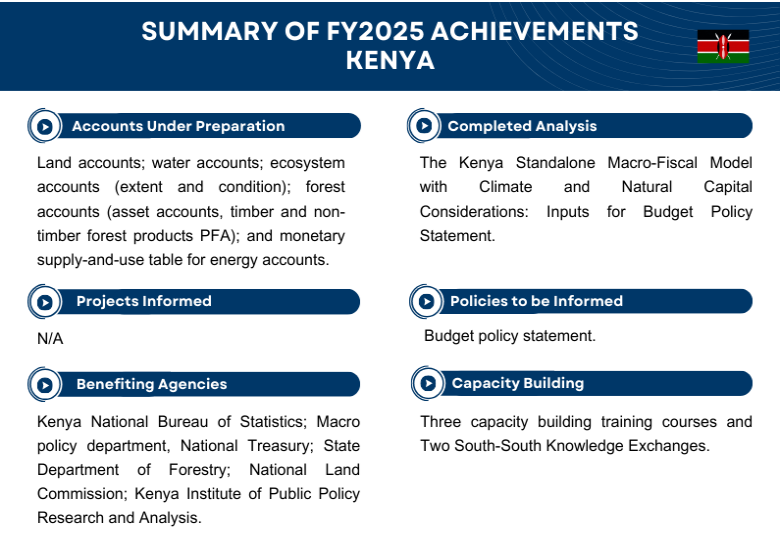
In FY25, activities under the CIC grant in Kenya made progress in Natural Capital Accounting across several domains related to land, water, ecosystem, forest, and energy. The main achievement was the formation of technical working groups (TWGs) for land, forest, and ecosystem accounts with representation from multiple ministries, departments and agencies (there were existing water and energy technical working groups). In addition, the support enabled compilation of data (in close coordination with the TWGs) and capacity building of the TWGs.
- Water: A physical water input-output table and SEEA-style Water Supply and Use Table have been developed.
- Ecosystem accounts: A draft report on extent and condition has been completed.
- Energy: A monetary supply and use table was developed for the first time, accompanying the physical supply and use tables.
- Forests: Aata for asset accounts for timber and non-timber products has been compiled.
Further development and finalization of this work is foreseen for FY26, including contributing to a compendium on natural capital for Kenya that will be issued by the Kenya National Bureau of Statistics.
Beyond natural capital accounting, the GPS grant also equipped the National Treasury with tools and analytical capacity to embed climate and natural capital into its macro-fiscal modeling. Through the previous TTA on "Strengthening Natural Capital and Climate Policy and Governance" technical assistance, the World Bank and Treasury co-developed an augmented KENMOD, a Kenya-specific extension of the Macroeconomic and Fiscal Model (MFMOD). KENMOD was augmented to include climate and natural capital channels. The new GPS CIC grant ("Integrating natural capital and ecosystem service considerations in macro- and investment decisions") supported several hands-on trainings with the Macro and Fiscal Affairs Department to build internal capacity to run scenarios, calibrate climate and natural capital parameters, and interpret results for policy.
The new report on "Kenya Standalone Macro-Fiscal Model with Climate and Natural Capital Considerations: Inputs for Budget Policy Statement" produced policy-shock simulations on GDP, household consumption, private investment, inflation, and fiscal aggregates, quantifying the macro impacts of climate shocks and the benefits and trade-offs of green fiscal measures and restoration investments.
The progress in developing these accounts and the report, along with the technical support for capacity building helped accelerate the formal adoption of Kenya’s National Plan for Advancing Environmental-Economic Accounting (NP-AEEA), Kenya’s national roadmap for integrating natural capital into official statistics and decision-making. The GPS support will help operationalize the NP-AEEA and supports Kenya’s ambition to align its statistical systems with its sustainable development priorities, by providing harmonized, spatially explicit data on how land resources are changing, and why these changes matter for national planning, investment, and climate action.
Informing policies
The GPS grant informed Kenya’s Budget Policy Statement (BPS) through the KENMOD analysis. It fed directly into BPS preparation by improving the evidence base for setting strategic priorities, informing sector ceilings and national–county allocations with quantified climate risks, testing consistency of proposed measures with growth, inflation, and debt objectives, and strengthening coherence across climate, natural capital, and fiscal policy.
The GPS-financed work also addressed data gaps and modeling readiness, enabling Treasury to iteratively use KENMOD for the BPS cycle to prioritize resilient, low-carbon investments and to transparently communicate macro-fiscal implications of climate policy.
Capacity Building
In FY25, Kenya advanced its capacity building and institutionalization efforts in natural capital accounting and environmental management through a series of targeted events and trainings. Under GPS support, it organized both virtual (with Uganda and South Africa) and in-person (with Zambia) South-South Exchange sessions, bringing together a diverse group of agencies including the Climate Change Directorate, Kenya Space Agency, National Land Commission, and others. The virtual exchange engaged 65 participants, with 17 women, while the in-person event included 17 participants from key regulatory and statistical organizations.
Additionally, Kenya conducted one-day capacity building trainings on Land Accounts, Ecosystems Extent Accounts, and Ecosystems Condition Accounts, each involving 13 to 20 participants and strong female representation.