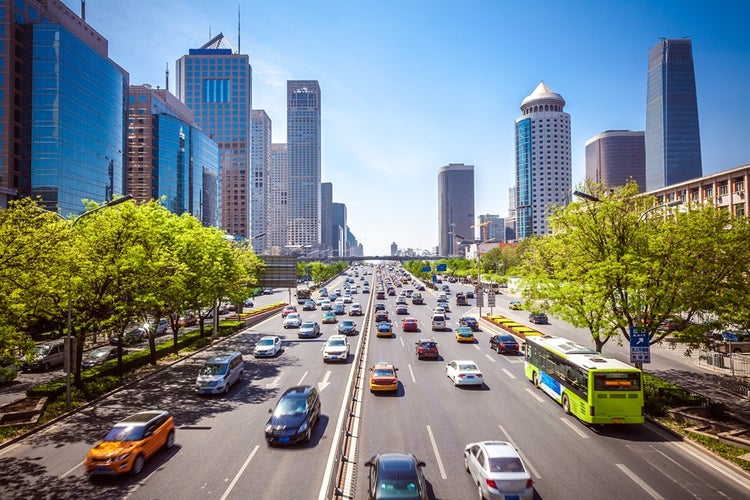
China’s strong growth relied on investment and export-oriented manufacturing, an approach that has largely reached its limits and led to economic and environmental imbalances. A rapidly aging population presents additional challenges: a declining labor force is slowing GDP growth, while the growing ranks of the old could put pressure on public finances. Addressing these challenges will require stronger productivity growth and a shift in economic structure from manufacturing to high-value services, from investment to consumption, and from high to low carbon intensity.
Given its size, China is central to many regional and global development issues. Global climate challenges cannot be solved without China’s engagement. Although not the main source of historical cumulative emissions, China now accounts for a third of annual global carbon dioxide and 30 percent of greenhouse gas emissions, with per capita emissions now surpassing those of the European Union and on par with the average for the Organization for Economic Co-operation and Development (OECD). Achieving China’s goals of peaking carbon emissions before 2030 and reaching carbon neutrality by 2060 is crucial for mitigating climate change. China’s growing economy is also an important source of global demand. Its economic rebalancing will create new opportunities for manufacturing exporters, although it may reduce demand for commodities over the medium term.