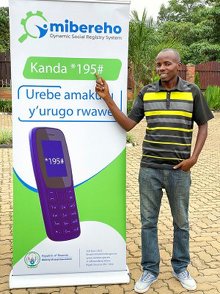
Household registration underway during the launch of the Imibereho Social Registry system in Kagugu Cell, City of Kigali, Rwanda, on January 17, 2024.
As of 2024, 62 countries have operationalized social registries to reduce fragmentation and improve coordination across social programs—now covering 1.1 billion people globally. Twenty nine (29) of these countries—of which 17 are supported by the World Bank—are extending the use of social registries beyond social protection to support labor market programs, health, education, and subsidy programs among others. Increasingly, registries are becoming dynamic, i.e., using up-to-date data to deliver support more effectively and respond better to shocks.
Key Highlights
The World Bank supported Social Registries—information systems that collect and manage household and individual data to help identify and support beneficiaries to access social programs and services—across 34 countries reaching around 713 million people worldwide since 2001.
Rwanda’s Imibereho Social Registry supported by the World Bank now covers 13.8 million people. It has evolved into a national platform supporting safety nets, economic inclusion, skills, and health insurance programs—reaching 11 million beneficiaries though insurance alone. Through data-driven retargeting, Rwanda is set to boost social protection spending efficiency by over 50%.
Lebanon’s DAEM Social Registry, supported though the Lebanon Emergency Social Safety Net Project (ESSN), registered half the population of the country in the first two months and has since evolved from an emergency response tool into a central platform, coordinating social assistance, economic inclusion, primary healthcare, and humanitarian programs.
The data and household profiles are updated continuously, and that allows us to make informed decisions based on evidence, not assumptions. In the past, the selection of beneficiaries was often based on local leaders’ opinions or hearsay, and that sometimes led to complaints. Now, people believe in the process because they know the data speaks for itself. It’s transparent and reliable.
Jeanne Umutoni
The Vice Mayor of Rwamagana District, Rwanda, in charge of social welfare
Challenge
In many countries, people who needed support must visit several government offices to access different services. This created confusion for families and increased costs for governments. To solve this, governments began creating social registries in the late 1990s—central systems that help reduce duplication and make it easier to access social protection. Today, these registries are becoming more advanced: they can connect and share data across different databases (called interoperability), allow real-time updates, and support services in health, education, housing, and jobs. This makes them powerful national digital tools.
World Bank Group Approach
The World Bank has been supporting governments in designing and strengthening social registries as core elements of social protection delivery systems. Many registries began as static databases, updated only at long intervals. With Bank support, several countries—including Rwanda—have transitioned to dynamic registries that are updated regularly, linked to national ID systems, and able to share data securely across sectors.
In countries such as Brazil, Rwanda, and Lebanon, social registries are already being used well beyond social protection to connect households with housing, utilities, health insurance, education, skills, economic inclusion and employment programs as pathways to jobs.
In Brazil, World Bank projects modernized the social protection system, enabling digital payments and financial inclusion for millions of low-income families. By linking beneficiaries to vocational training—as in the ongoing PRONTEC program—and other initiatives, the new system helped them transition from social assistance to the labor market. In Rwanda, the Imibereho Social Registry, supported by the World Bank, helped target safety nets, economic inclusion, and skills programs. Over 11 million people were covered by health insurance, and the registry linked vulnerable households to job training and entrepreneurship support.
To accelerate this progress, the World Bank has developed flexible, modular tools to help countries assess and strengthen delivery systems. These tools help countries build and scale registries and delivery systems as strategic national investments—not only for social protection, but increasingly as gateways to jobs and economic opportunities.
Contribution to WBG Targets and Jobs
Social registries contribute directly to the World Bank Group’s SP500 corporate target to reach 500 million people, half of them women, with social protection and labor programs by 2030. They also support the corporate gender target to deliver social protection programs to 250 million more women. Beyond social protection, registries connect individuals to health, education, economic inclusion, skills, and employment programs, expanding access to job opportunities. They are also increasingly used to deploy transfers that help mitigate the impacts of subsidy reforms on poor and vulnerable households.
Lessons Learned
Dynamic Social Registry System, RwandaSocial registries are most effective when designed as cross-sectoral public goods rather than program-specific targeting tools. Building a unified social registry, such as in Brazil, enables efficient delivery of benefits across dozens of programs, improving coordination and reducing duplication. Static systems risk exclusion and inefficiency, while dynamic registries—supported by digital innovation and sound governance—enable inclusive, real-time service delivery, particularly when paired with active outreach to poor and vulnerable groups, as in Brazil’s Active Search program, which sends trained personnel into communities to identify and register poor families into the national social registry (Cadastro Único), enabling access to programs like Bolsa Família, housing, and food assistance.
Experience from Rwanda and Lebanon highlights the importance of adaptable, scalable registry solutions. In Rwanda, starting with community-based classification fostered trust and local ownership, while transitioning to a national digital platform linked to ID and administrative data enabled broader integration and efficiency. In Lebanon, the emergency context demanded rapid deployment—digital registries proved capable of registering millions within weeks, supporting timely crisis response. Embedding registries within delivery systems enhances their utility across sectors and strengthens overall social protection systems.
Next Steps
The World Bank will continue supporting countries to establish and scale dynamic, interoperable registries as the backbone of delivery systems, with ongoing operations in Bangladesh, Zambia, Kosovo, and others. A priority is contributing to the SP500 corporate target—reaching 500 million people, half women, with social protection and labor programs by 2030—while embedding crisis response, gender inclusion, and digital service delivery in partnership with others.
Looking ahead, registries are increasingly positioned as springboards for broader service delivery. By integrating with public employment and labor programs, registries can directly link social protection, skills development, and employment opportunities—creating stronger pathways to jobs.
This site uses cookies to optimize functionality and give you the best possible experience. If you continue to navigate this website beyond this page, cookies will be placed on your browser. To learn more about cookies, click here.