From a young age, Leah Francis Basu was fascinated by the mechanics of an aircraft. “I loved aircrafts,” she recalls, describing the moment she first discovered the science of lift. “It was surprising to me to learn the Bernoulli’s principle, where air moving faster over the top of the wing creates lower pressure, while the air beneath the wing remains at higher pressure, forcing the aircraft upward to take off.”
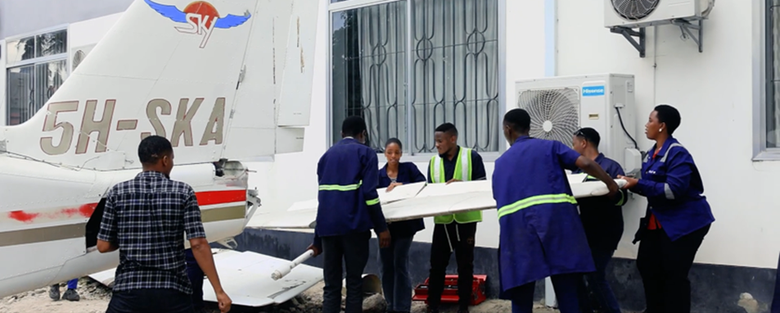
That curiosity evolved into a desire to work in the aviation industry as an aircraft maintenance engineer. Her dream became a reality when she joined the National Institute of Transport (NIT) in Tanzania, where she pursued Aircraft Maintenance Engineering. At NIT, she benefited from a scholarship under the World Bank-funded East Africa Skills for Transformation and Regional Integration Project (EASTRIP), which gave her the motivation to excel. “The scholarship gave me the drive to study hard and accomplish my dreams,” she says. “It created a debt in my mind that there are people who have invested financially in me, so I must do my best so they can see the fruits of their investment.”
She is now working with Precision Air, one of the leading Airlines in Tanzania, applying the hands-on technical skills she honed at NIT to ensure aircraft safety and reliability. “It means a lot to me to play a role in passenger safety and to contribute to Tanzania’s growing aviation industry,” she reflects.
NIT is one of 16 Regional Flagship TVET Institutes supported by the World Bank-funded East Africa Skills for Transformation and Regional Integration Project (EASTRIP), which has embedded industrial partnerships into over 500 programs, and is rolling out competency-based training to produce skilled labor and technicians in priority sectors, including agriculture, construction, energy, tourism, manufacturing and ICT sectors in Ethiopia, Kenya, and Tanzania. So far, the aggregate training capacity of the 16 flagships has increased by tenfold, and employment rate of its graduates increased from a baseline of 47 percent to 79 percent.
A Generation on the Move
Busu represents a generation of young Africans who, with access to the right opportunities, can become highly skilled professionals who can help drive national and regional growth. Across the Africa region, flagship technical and vocational institutes are demonstrating what is possible— through modernized curricula, upgraded training facilities, enhanced industry partnerships, and internationally recognized accreditation efforts, these institutions are producing graduates capable of meeting evolving labor-market demands.
The influence of such training extends beyond traditional sectors into creative and emerging industries as well. In Senegal, Abdoulaye Ba co-founded a start-up that uses virtual and augmented reality to promote cultural heritage through immersive digital experiences after a two-year program in Graphic and Digital Art at the Institut Supérieurs d'Enseignement Professionnel (ISEP) of Thiès. Their work illustrates how skilled youth are now creating value in tourism, art, and education using cutting-edge technologies, underscoring the economic potential unlocked when training aligns with innovation.
Yet stories like Basu and Ba’s unfold against a broader challenge: every month, around one million young Africans enter the job market, while formal opportunities remain scarce. Nearly 23 percent of youth are not in education, employment, or training, and 86 percent of 10-year-olds cannot read a simple text—a foundational learning crisis that has consequences through the entire skills value chain and weakens the skills pipeline, limiting young people’s readiness for higher-level training and the specialized competencies required by employers. Skill gaps are holding back development goals in several key sectors as well, including energy access, quality healthcare, agriculture, tourism, and value-added manufacturing. Furthermore, women’s participation in technical fields remain low, while internet and electricity constraints continue to limit the effective use of modern training equipment in many institutions.
“Our efforts to provide 300 million people in Africa with access to electricity requires a skilled workforce across the entire energy supply chain; we need local investments in skilling systems to execute and implement Mission 300,” said Erik Fernstrom, Director for Infrastructure in East and Southern Africa for the World Bank Group.
A New Push: The Africa Skills for Jobs Policy Academy
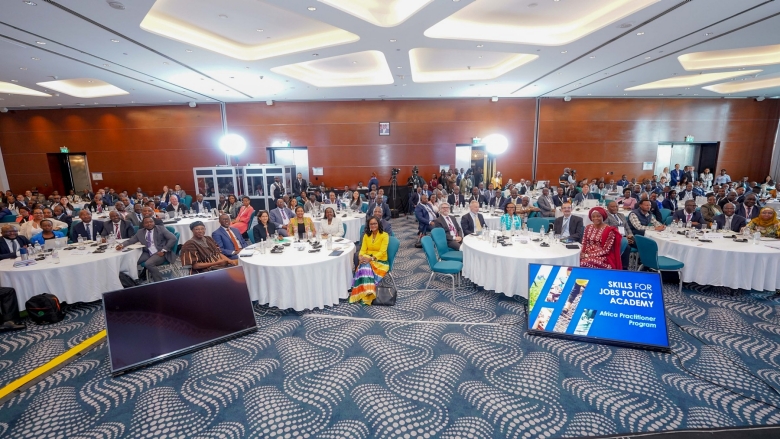
To meet these challenges, the World Bank Group (WBG) launched the Skills for Jobs Policy Academy to share global evidence, innovations, and practical tools for effective skills development. Organized jointly with the Government of Kenya and the Inter-University Council for East Africa (IUCEA), the Academy took place in Nairobi, Kenya, between September 29 to October 3, 2025. Over 300 senior policymakers from about 25 Sub-Saharan African countries and World Bank operational staff participated in an intensive, practice-focused program.
“Skill building is a lifelong journey: it begins in early childhood and must continue through school, training, and the workplace. Too often that continuum breaks down,” said Mamta Murthi, Vice President, People, World Bank Group, in her opening remarks. According to Murthi, the Africa Skills for Jobs Policy Academy marks a turning point and reflects the World Bank’s sharper focus on jobs and workforce development, while sustaining the Bank’s commitment to early learning.
When youth acquire relevant, industry-aligned technical skills, they gain access to dignified work, higher earnings, and entrepreneurial opportunities. At the same time, skilled technicians and operators reinforce national competitiveness, accelerate technological adoption, support infrastructure development, and drive productivity gains essential for poverty reduction. This was further highlighted by Ndiamé Diop, Vice President for Eastern and Southern Africa at the World Bank Group who stated at the event opening that skills are the bridge to economic transformation since economies cannot move into competitive manufacturing and digital industries without stronger skills systems. “Delivering these skills requires rethinking our systems and employers must be at the center,” he said. Acknowledging the centrality of industry and employers, Luis Benveniste, Global Director of Education at the World Bank observed that “System-level reforms take time. But quick wins, like partnering with firms and providers in priority sectors where there is demand, can deliver impact and momentum.”
A highlight of the event was the High-Level Private Sector and Ministerial Roundtable, which brought together six State Ministers, over 16 business leaders from agribusiness, energy, construction, tourism, and finance, and World Bank senior leadership. Discussions focused on sectoral skills gaps and concrete avenues for public-private collaboration, with industry participants emphasizing the need to move beyond mere talk, and towards jointly financed, results-oriented initiatives and broader, more active collaboration. “One of the most powerful moments of the week for me was the private sector roundtable” said Mary Porter Peschka, IFC’s Regional Director. She noted that industry leaders came together to clearly articulate the skills needed, the training models that work, and their readiness to collaborate with governments to make this happen.