col-xs-12
col-sm-12
col-md-1
col-lg-1
col-xs-12
col-sm-12
col-md-10
col-lg-10
col-xs-12
col-sm-12
col-md-1
col-lg-1
col-xs-12
col-sm-12
col-md-12
col-lg-12
videoType
you-tube
videoUrl
fsCSNGh5gF0
title
Antimicrobial resistance (AMR) is invisible, I am not: Videos by WHO's Task Force of AMR survivors
keyFrameImage
https://i.ytimg.com/vi/fsCSNGh5gF0/maxresdefault.jpg
description
Every year, antibiotics and other antimicrobials save millions of lives. But a phenomenon known as antimicrobial resistance (AMR) threatens the effectiveness of these life-saving medicines. AMR occurs when bacteria, viruses, fungi and parasites no longer respond to antimicrobials. AMR is invisible but its victims are not. The World Health Organization’s ‘AMR is invisible, I am not’ campaign puts advocates—like Vanessa, Ella and Brandon from the WHO Task Force of AMR survivors—front and centre, to share their stories, raise awareness and urge action to address AMR. Find out more about the campaign and AMR on WHO’s website: www.who.int/campaigns/world-amr-awareness-week/2024/amr-is-invisible-i-am-not, https://www.who.int/health-topics/antimicrobial-resistance
showTimestampAndTranscript
no
duration
69
lastUploadedDate
2024-06-24T18:52:23Z
col-xs-12
col-sm-12
col-md-3
col-lg-3
col-xs-12
col-sm-12
col-md-7
col-lg-7
  • font-medium
  • bg_blue_05
Antimicrobial Resistance (AMR) poses a growing global health crisis, especially in Africa, where drug-resistant infections drive rising mortality. Misuse of antimicrobials and inadequate water, sanitation, and vaccination are key contributors. The World Bank’s programs, such as REDISSE and HEPRR, invest in One Health approaches, AMR surveillance, and workforce training while promoting local pharmaceutical development and tackling substandard medicines. Coordinated action is critical to mitigate AMR and ensure sustainable health solutions.
col-xs-12
col-sm-12
col-md-2
col-lg-2
col-xs-12
col-sm-12
col-md-3
col-lg-3
col-xs-12
col-sm-12
col-md-7
col-lg-7
  • lp-body-content
  • first-letter

Addis Ababa, November 18, 2024—“I have lived with HIV my whole life, but it’s not HIV that I am worried about,” says Brandon Jaka from Zimbabwe, “It’s what follows, when medicines that are supposed to treat infections fail to do so.” Brandon is part of the World Health Organization’s (WHO) taskforce of Antimicrobial Resistance survivors, and you can watch his story here.

Antimicrobial Resistance (AMR), according to the WHO, occurs when bacteria, viruses, fungi and parasites no longer respond to antimicrobial medicines, mainly due to the misuse and overuse of antimicrobials to treat, prevent, or control infections in humans, animals, and plants. AMR is a silent but serious global health emergency. In Africa, it has now become a significant cause of mortality, with deaths from infectious diseases such as malaria, HIV, and tuberculosis being largely caused by drug-resistant strains of these diseases.

What causes AMR? The careless use of antimicrobials is a definite part of the cause, but in Africa, a lack of access to clean water, sanitation, and vaccination are also contributory factors. The African Union’s AMR Landmark Report estimates that investments in water, sanitation and hygiene, infection prevention, and biosecurity could save 700,000 lives a year on the continent.
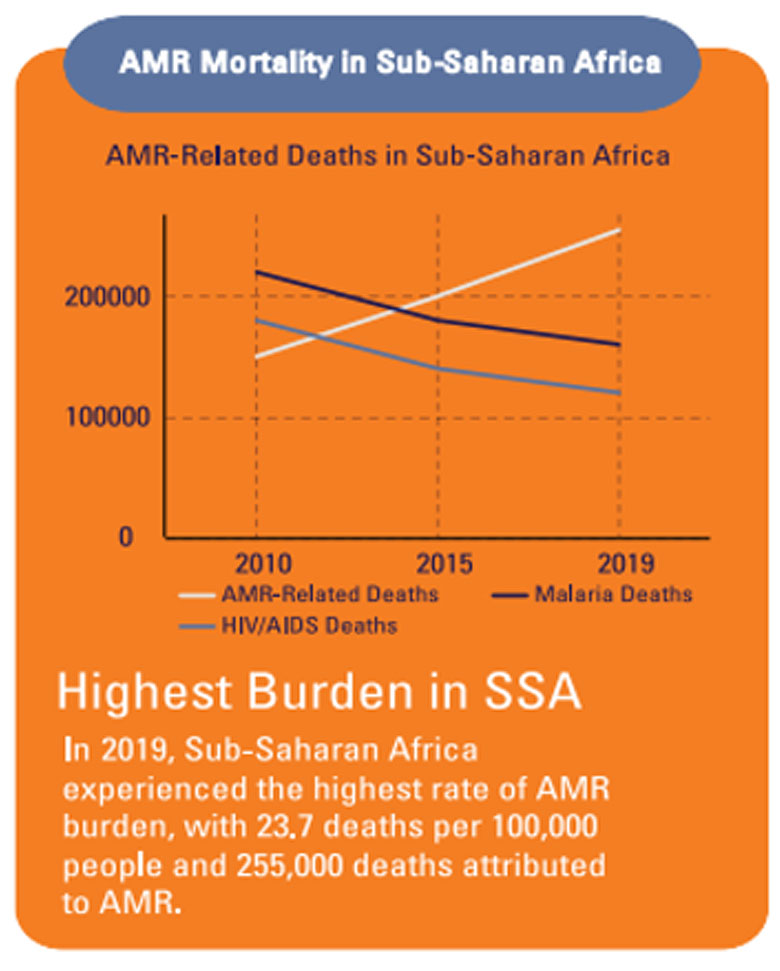
Source: African Union AMR Landmark Report, 2024

The need for coordinated actionAfrican countries are committed to tackling AMR, but translating the AU Framework for AMR Control (2020-2025) into action requires strong coordination across sectors and countries. This is important because AMR cuts across human, animal, and environmental health and requires effective national and regional regulatory frameworks for medicines.

World Bank investments to combat AMRThe World Bank has invested in One Health and specifically in AMR efforts for more than a decade, and is working to support governments in designing and implementing approaches to preserve antimicrobials with financing and technical assistance. Our new Framework for Action helps World Bank teams and clients in designing interventions that address AMR, with a focus on low- and middle-income countries (LMICs), which stand to be disproportionately impacted. This Framework outlines 20 intervention areas across the health, agriculture, and water sectors that can serve as starting points for discussions to develop sustainable systems addressing AMR at the national and regional levels.

Established in the aftermath of the 2014-2016 Ebola outbreak in West Africa, the Regional Disease Surveillance Systems Enhancement (REDISSE) Program engaged 16 countries in West and Central Africa and is benefiting almost half a billion people through a total financing of US$ 670.13 million.This program was instrumental in supporting countries to establish One Health platforms which were critical to bring together human, animal, and environmental health and set forth integrated planning for AMR.

Today, two new regional programs include significant investments in AMR, among other health emergencies faced by African countries. The $1.5 billion Health Emergency Preparedness, Response, and Resilience (HEPRR) Program covers eight countries so far in Eastern and Southern Africa (Burundi, the Democratic Republic of Cong (DRC), Ethiopia, Kenya, Malawi, Rwanda, Sao Tome & Principe, and Zambia), while the $500 million Health Security Program covers three countries in West and Central Africa (Cabo Verde, Guinea, and Liberia). Regional organizations also receive financing under these programs. The Global Financing Facility and the Pandemic Fund provide some co-financing at the country level.

https://delivery-p136806-e1377785.adobeaemcloud.com/adobe/assets/urn:aaid:aem:5d4994b5-5144-435c-8bd6-a1e46d9ee15e/as/zw-ig-1.jpg
col-xs-12
col-sm-12
col-md-2
col-lg-2
  • lp-body-content
  • first-letter
col-xs-12
col-sm-12
col-md-1
col-lg-1
col-xs-12
col-sm-12
col-md-10
col-lg-10
expert-quote
The HEPPR Program presents a unique opportunity to bring a new impetus to fight against AMR by bringing sustainable financing to African countries. I am excited to see participating countries making investment in key fronts of this fight.
João Pires
Senior Health Specialist, Health, Nutrition, and Population Global Practice at the World Bank
false
col-xs-12
col-sm-12
col-md-1
col-lg-1
col-xs-12
col-sm-12
col-md-3
col-lg-3
col-xs-12
col-sm-12
col-md-7
col-lg-7
  • lp-body-content

The focus of efforts:

First, evidence and data. Countries will generate high-quality evidence on AMR prevalence, through activities such as nationally representative AMR surveys with support from WHO; improving the representativeness and quality of AMR data; and strengthening laboratory information systems and data management.

Second, strengthening AMR surveillance and diagnostic capacity. This will be done through the expansion of subnational sentinel sites to strengthen AMR surveillance, digitalization of integrated antimicrobial use, consumption and resistance surveillance networks, expansion of whole genome sequencing and susceptibility testing, and strengthening cross-border laboratory partnerships.

Third, building a skilled and competent multidisciplinary health workforce for AMR, focusing on AMR governance across human and animal health, developing AMR and infection prevention and control (IPC) competency frameworks and curriculum, as well as training laboratory personnel.

What’s next for medicines in AfricaWhile strengthening mechanisms for mitigating AMR in Africa is critical, countries must also address the lack of access to appropriate, safe, effective, and affordable antimicrobials and diagnostic tools. The HEPRR program will also focus on developing regional pharmaceutical and vaccine manufacturing and logistical capacities, premised on a strong regulatory ecosystem and a reliable market ecosystem, which is imperative to addressing Africa’s reliance on imports.

Countries must also address the reality that substandard and falsified medicines are being manufactured, procured, and imported illegally. What is needed are mechanisms that allow local populations suffering the impact of these substandard medicines to report on this, with regional harmonization around risk-based sampling methods for post market surveillance that can encourage better detection.

“In sum, AMR is a ticking time bomb; if we do not work quickly, constructively, and collaboratively, humanity and future generations will pay a very heavy price,” said Ramesh Govindaraj, World Bank Lead Specialist, Health, Nutrition, and Population Global Practice.

lp-heading-top-medium
lp-heading-bottom-medium
col-xs-12
col-sm-12
col-md-2
col-lg-2
  • lp-body-content