


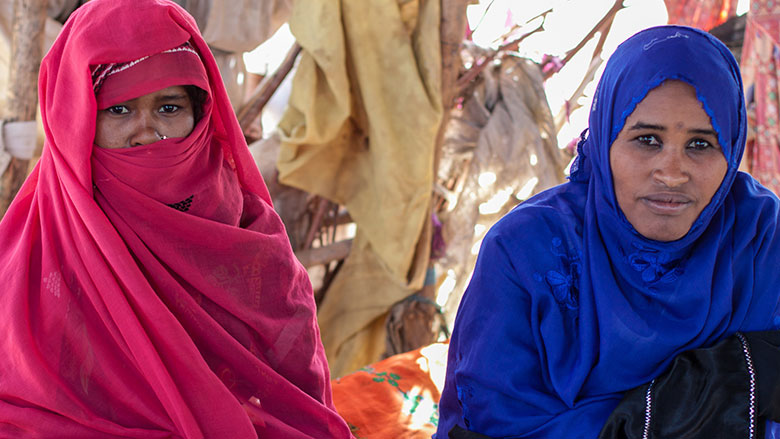
KHARTOUM, May 12, 2021 – In the beginning of the COVID-19 (coronavirus) pandemic, Amal Awad, a 48-year-old from Aljazeera state, and her four children were terrified to leave their home. As a housewife, she could manage care of the home and the children, but her husband’s income from his informal job deteriorated significantly during the crisis, and the family suffered from daily price hikes on food and fuel.
“My son also had to give back the Raksha [small taxi] he drives to its owner as there was no income generated from it due to movement restrictions,” she said.
The Amal family, like many households throughout the country, did not receive aid from the government and continues to experience unprecedented social and economic impact of the COVID-19 pandemic and the restrictions imposed by Sudanese authorities to curb the spread of the virus. To better assess the impact of COVID-19 on households, the World Bank and the Central Bureau of Statistics (CBS) jointly carried out the first survey of its kind in the country: the Sudan High Frequency Survey on COVID-19, using mobile phones.
“The Central Bureau of Statistics has carried out this survey with the World Bank, aiming to inform policy making and government responses to contain the impact of the pandemic,” said Ali Abbas, Director General, the Central Bureau of Statistics (CBS).”
The ongoing panel survey provides a snapshot of the impact of the pandemic on households, with the aim of monitoring the COVID-19 crisis and assessing the dynamics of its effects over time.
“We are pleased with our strategic partnership with the Central Bureau of Statistics (CBS) to improve statistics and evidence base data in Sudan which is crucial to minimize the spread of the virus. We are grateful for the UK funding that made this survey possible,” said Milena Petrova Stefanova, World Bank Country Manager for Sudan during the virtual dissemination event of the survey round 1 results.
The survey of 4,032 rural and urban households across the 18 states of Sudan has shed light on the socio-economic impact of COVID-19 through a first round of questions, June 16—July 5, 2020 (three additional rounds have since been conducted between August 2020 and April 2021). The findings, highlighted in the Socioeconomic Impact of COVID-19 on Sudanese Households policy note, reveal that nearly everyone (98%) reported to be aware of COVID-19, and more than 70% of the respondents have adopted basic hygiene and social distancing measures. About 47% of households reported being worried about food security, and many modified their eating habits (Figure 1). More than 20% of the householdscould no longer afford to buy bread, cereals as well as dairy products due to price increases (Table 1).
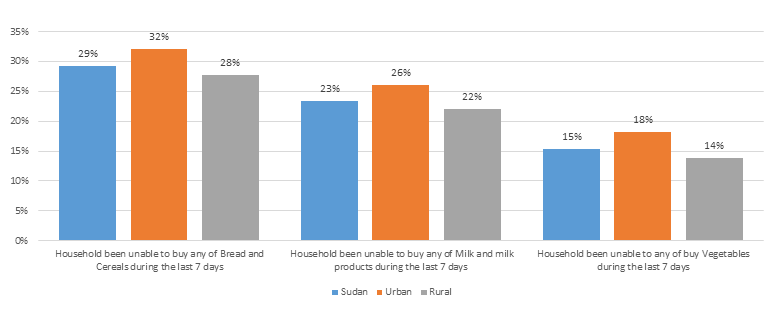
Table 1: % of households unable to access main staple foods
Total | Urban | Rural | |
Bread and Cereals | 52% | 59% | 48% |
Milk and milk products | 70% | 78% | 65% |
Vegetables | 66% | 79% | 56% |
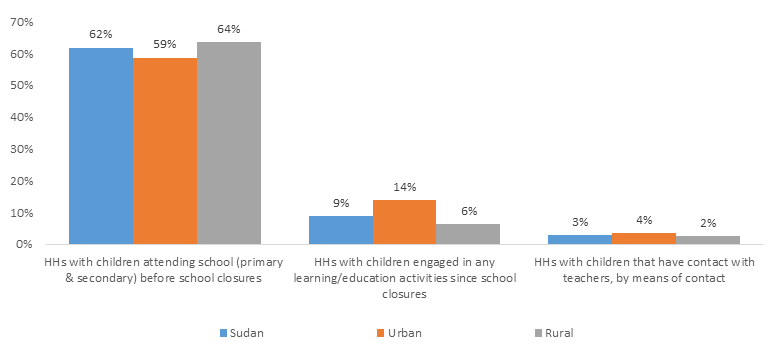
Furthermore, school closures due to COVID-19 significantly disrupted children’s access to education, with only 9% of the households with school-aged children attending school before the COVID-19 outbreak engaged in learning activities (Figure 2).
Another key finding from the survey is that about 67% of the respondents who worked before the COVID-19 lockdown still had not returned to work by the time of the survey. This is mainly comprised of self-employed people or business owners. Additionally, social assistance programs were non-existent, as only 3% of households reported receiving social assistance of any kind. To cope with income losses, households reduced their food and non-food consumption, drew on their savings, and resorted to on-credit purchases.
In addition to providing a window into households’ conditions at that time, the survey offers insight for designing the right government social protection system to minimize the impact of the pandemic. Representatives of the Ministry of Labor and Social Development said the results are very informative for expanding their social assistance efforts.
